
Full resolution (JPEG) - On this page / på denna sida - Route in Northern Arabia
<< prev. page << föreg. sida << >> nästa sida >> next page >>
Below is the raw OCR text
from the above scanned image.
Do you see an error? Proofread the page now!
Här nedan syns maskintolkade texten från faksimilbilden ovan.
Ser du något fel? Korrekturläs sidan nu!
This page has never been proofread. / Denna sida har aldrig korrekturlästs.
[-ami-]{+Dr. Wallin’s Route in Northern Arabia.
29
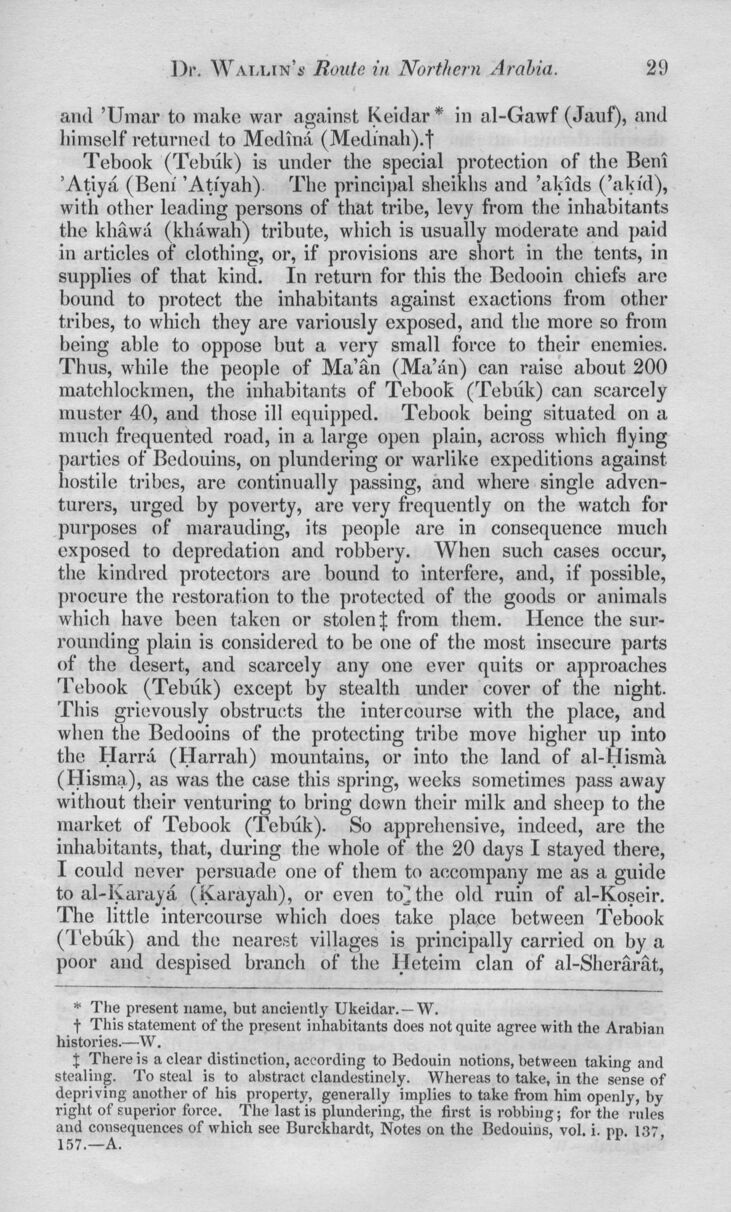
ami+} ’Umar to make war against Keidar * in al-Gawf (Jauf), and
himself returned to Medina (Medinah).t
Tebook (Tebuk) is under the special protection of the Beni
’Atiya (Beni ’Ati’yah). The principal sbeikbs and ’akids (’aki’d),
with other leading persons of that tribe, levy from the inhabitants
the khawa (kliawah) tribute, which is usually moderate and paid
in articles of clothing, or, if provisions are short in the tents, in
supplies of that kind. In return for this the Bedooin chiefs are
bound to protect the inhabitants against exactions from other
tribes, to which they are variously exposed, and the more so from
being able to oppose but a very small force to their enemies.
Thus, while the people of Ma’an (Ma’an) can raise about 200
matchlockmen, the inhabitants of Tebook (Tebuk) can scarcely
muster 40, and those ill equipped. Tebook being situated on a
much frequented road, in a large open plain, across which flying
parties of Bedouins, on plundering or warlike expeditions against
hostile tribes, are continually passing, and where single
adventurers, urged by poverty, are very frequently on the watch for
purposes of marauding, its people are in consequence much
exposed to depredation and robbery. When such cases occur,
the kindred protectors are hound to interfere, and, if possible,
procure the restoration to the protected of the goods or animals
which have been taken or stolen | from them. Hence the
surrounding plain is considered to be one of the most insecure parts
of the desert, and scarcely any one ever quits or approaches
Tebook (Tebiik) except by stealth under cover of the night.
This grievously obstructs the intercourse with the place, and
when the Bedooins of the protecting tribe move higher up into
the Harra (Harrah) mountains, or into the land of al-Hisma
(Hisma), as was the case this spring, weeks sometimes pass away
without their venturing to bring down their milk and sheep to the
market of Tebook (Tebuk). So apprehensive, indeed, are the
inhabitants, that, during the whole of the 20 days I stayed there,
I could never persuade one of them to accompany me as a guide
to al-lyaraya (Karayah), or even to) the old ruin of al-Koseir.
The little intercourse which does take place between Tebook
(Tebuk) and the nearest villages is principally carried on by a
poor and despised branch of the Heteiin clan of al-Sherarat,
* The present name, but anciently Ukeidar. —W.
f This statement of the present inhabitants docs not quite agree with the Arabian
histories.—\V.
t There is a clear distinction, according to Bedouin notions, between taking and
stealing. To steal is to abstract clandestinely. Whereas to take, in the sense of
depriving another of bis property, generally implies to take from him openly, by
right of superior force. The last is plundering, the first is robbing; for the rules
and consequences of which see Burckhardt, Notes on the Bedouins, vol. i. Tin. 137
157.—A.
<< prev. page << föreg. sida << >> nästa sida >> next page >>


