
Full resolution (JPEG) - On this page / på denna sida - Route in Northern Arabia
<< prev. page << föreg. sida << >> nästa sida >> next page >>
Below is the raw OCR text
from the above scanned image.
Do you see an error? Proofread the page now!
Här nedan syns maskintolkade texten från faksimilbilden ovan.
Ser du något fel? Korrekturläs sidan nu!
This page has never been proofread. / Denna sida har aldrig korrekturlästs.
[-themselves-]{+36
Dr. Wallin’.? Route in Northern Arabia.
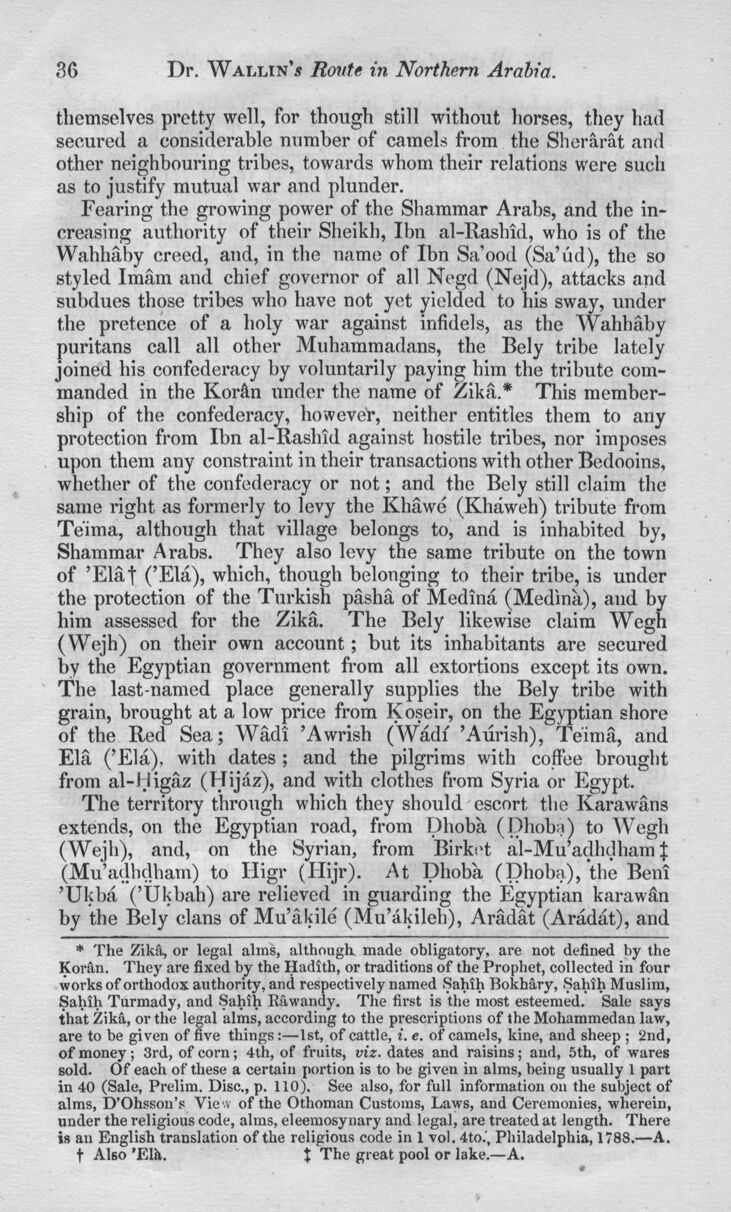
themselves+} pretty well, for though still without horses, they had
secured a considerable number of camels from the Sherarat and
other neighbouring tribes, towards whom their relations were such
as to justify mutual war and plunder.
Fearing the growing power of the Shammar Arabs, and the
increasing authority of their Sheikh, Ibn al-Rashid, who is of the
Wahhaby creed, and, in the name of Ibn Sa’ood (Sa’ud), the so
styled Imam and chief governor of all Negd (Nejd), attacks and
subdues those tribes who have not yet yielded to his sway, under
the pretence of a holy war against infidels, as the Wahhaby
puritans call all other Muhammadans, the Bely tribe lately
joined his confederacy by voluntarily paying him the tribute
commanded in the Kor&n under the name of Zika.* This
membership of the confederacy, however, neither entitles them to any
protection from Ibn al-Rashid against hostile tribes, nor imposes
upon them any constraint in their transactions with other Bedooins,
whether of the confederacy or not; and the Bely still claim the
same right as formerly to levy the Kliftwe (Kliaweh) tribute from
Teima, although that village belongs to, and is inhabited by,
Shammar Arabs. They also levy the same tribute on the town
of ’Elaj (’Ela), which, though belonging to their tribe, is under
the protection of the Turkish pasha of Medina (Medina), and by
him assessed for the Zika. The Bely likewise claim Wegh
(Wejh) on their own account; but its inhabitants are secured
by the Egyptian government from all extortions except its own.
The last-named place generally supplies the Bely tribe with
grain, brought at a low price from Koseir, on the Egyptian shore
of the Red Sea; Wadi ’Awrish (VVadf ’Aurish), Teima, and
Ela (’Ela), with dates ; and the pilgrims with coffee brought
from al-l.ligaz (Hijaz), and with clothes from Syria or Egypt.
The territory through which they should escort the Karawans
extends, on the Egyptian road, from Dhoba (Dhobi) to Wegh
(Wejh), and, on the Syrian, from Birket al-Mu’adhdham |
(Mu’adhdham) to Hisr (Hijr). At Dhoba (Dhoba), the Beni
’Ukba (’Ukbah) are relieved in guarding the Egyptian karawan
by the Bely elans of Mu’akile (Mu’akileh), Aradat (Aradat), and
* The Zika, or legal alms, although, made obligatory, are not defined by the
Korin. They are fixed by the Hadith, or traditions of the Prophet, collected in four
works of orthodox authority, and respectively named .Sahih Bokhlry, .Sahih Muslim,
Sahih Turmady, and Salith Rawandy. The first is the most esteemed. Sale says
that Zika, or the legal alms, according to the prescriptions of the Mohammedan law,
are to be given of five tilings:—1st, of cattle, i. e. of camels, kine, aud sheep ; 2nd,
of money; 3rd, of corn; 4th, of fruits, viz. dates and raisins; and, 5th, of wares
sold. Of each of these a certain portion is to be given in alms, being usually 1 pan
in 40 (Sale, Prelim. Disc., p. 110). See also, for full information on the subject of
alms, D’Ohsson’s View of the Othoman Customs, Laws, and Ceremonies, wherein,
under the religious code, alms, eleemosynary aud legal, are treated at length. There
is an English translation of the religious code in 1 vol. 4to.’, Philadelphia, 1788.—A.
t Also ’Elk. t The great pool or lake.—A.
<< prev. page << föreg. sida << >> nästa sida >> next page >>


