
Full resolution (JPEG) - On this page / på denna sida - Route in Northern Arabia
<< prev. page << föreg. sida << >> nästa sida >> next page >>
Below is the raw OCR text
from the above scanned image.
Do you see an error? Proofread the page now!
Här nedan syns maskintolkade texten från faksimilbilden ovan.
Ser du något fel? Korrekturläs sidan nu!
This page has never been proofread. / Denna sida har aldrig korrekturlästs.
[-al-IIagara-]{+Dr. Wallin’s Route in Northern Arabia.
51
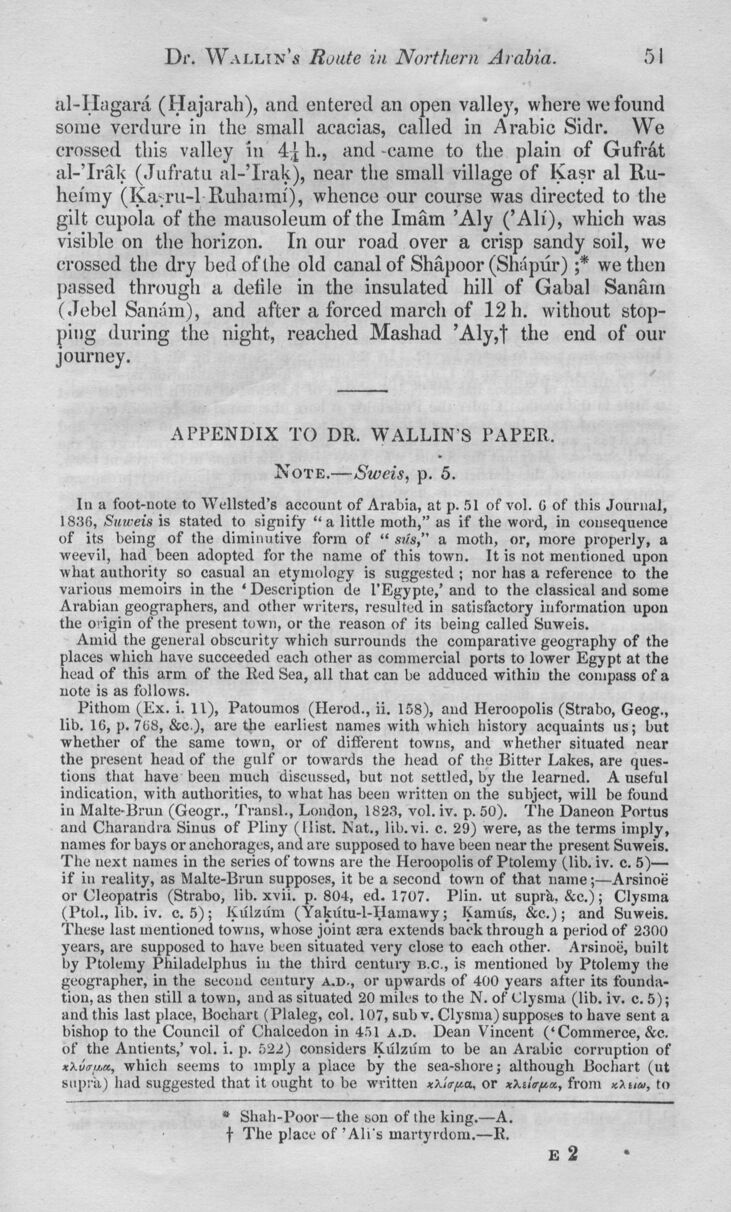
al-IIagara+} (Hajarah), and entered an open valley, where we found
some verdure in the small acacias, called in Arabic Sidr. We
crossed this valley in 4£ h., and -came to the plain of Gufrat
al-’Irak (Jufratu al-’Irak), near the small village of Kasr al
Ru-heiiny (Ka ru-1 Rubaimi), whence our course was directed to the
gilt cupola of the mausoleum of the Imam ’Aly (’All), which was
visible on the horizon. In our road over a crisp sandy soil, we
crossed the dry bed of the old canal of Shapoor (Slmpur) ;* we then
passed through a delile in the insulated hill of Gabal Sanain
(Jebel Sanam), and after a forced march of 12 h. without
stopping during the night, reached Mashad ’Aly,t the end of our
journey.
APPENDIX TO DR. WALLIN S PAPER.
Note.—Sweis, p. 5.
In a foot-note to Wellsted’s account of Arabia, at p. 51 of vol. C of this Journal,
1836, Suweis is stated to signify “a little moth,” as if the word, in consequence
of its being of the diminutive form of “ sus," a moth, or, more properly, a
weevil, had been adopted for the name of this town. It is not mentioned upon
what authority so casual an etymology is suggested ; nor has a reference to the
various memoirs in the * Description de I’Egypte/ and to the classical and some
Arabian geographers, and other writers, resulted in satisfactory information upon
the origin of the present town, or the reason of its being called Suweis.
Amid the general obscurity which surrounds the comparative geography of the
places which have succeeded each other as commercial ports to lower Egypt at the
head of this arm of the lied Sea, all that can be adduced within the compass of a
note is as follows.
Pithom (Ex. i. 11), Patoumos (Herod., ii. 158), and Heroopolis (Strabo, Geog.,
lib. 16, p. 768, &c ), are the earliest names with which history acquaints us; but
whether of the same town, or of different towns, and whether situated near
the present head of the gulf or towards the head of the Bitter Lakes, are
questions that have been much discussed, but not settled, by the learned. A useful
indication, with authorities, to what has been written on the subject, will be found
in Malte-Brun (Geogr., Transl., London, 1823, vol. iv. p. 50). The Daneon Portus
and Charandra Sinus of Pliny (Hist. Nat., lib.vi. c. 29) were, as the terms imply,
names for bays or anchorages, and arc supposed to have been near the present Suweis.
The uext names in the series of towns are the Heroopolis of Ptolemy (lib. iv. c. 5)—
if in reality, as Malte-Bruu supposes, it be a second town of that name;—Arsinoe
or Cleopatris (Strabo, lib. xvii. p. 804, ed. 1707. Plin. ut suprh, &c.) ; Clysma
(Ptol., lib. iv. c. 5); Kulzum (Yakutu-l-I.Iamawy; Kamus, &c.)j and Suweis.
These last mentioned towns, whose joint tcra extends back through a period of 2300
years, are supposed to have been situated very close to each other. Arsinoe, built
by Ptolemy Philadelphus in the third century n.c., is mentioned by Ptolemy the
geographer, in the second century a.d., or upwards of 400 years after its
foundation, as then still a town, and as situated 20 miles to the N. of Clysma (lib. iv. c. 5);
and this last place, Bochart (Plaleg, col. 107, sub v. Clysma) supposes to have sent a
bishop to the Council of Chalcedon in 451 a.d. Dean Vincent (‘Commerce, &c.
of the Autients,’ vol. i. p. 522) considers Kulzum to be an Arabic corruption of
JckutruM, which seems to imply a place by the sea-shore; although Bochart (ut
supra) hud suggested that it ought to be written xXirpa. or from to
<< prev. page << föreg. sida << >> nästa sida >> next page >>


