 Note:
Gunnar Myrdal died in 1987, less than 70 years ago.
Therefore, this work is protected by copyright,
restricting your legal rights to reproduce it.
However, you are welcome to view it on screen, as you do now.
Read more about copyright.
Note:
Gunnar Myrdal died in 1987, less than 70 years ago.
Therefore, this work is protected by copyright,
restricting your legal rights to reproduce it.
However, you are welcome to view it on screen, as you do now.
Read more about copyright.

Full resolution (TIFF) - On this page / på denna sida - Footnotes - Chapter 40
<< prev. page << föreg. sida << >> nästa sida >> next page >>
Below is the raw OCR text
from the above scanned image.
Do you see an error? Proofread the page now!
Här nedan syns maskintolkade texten från faksimilbilden ovan.
Ser du något fel? Korrekturläs sidan nu!
This page has never been proofread. / Denna sida har aldrig korrekturlästs.
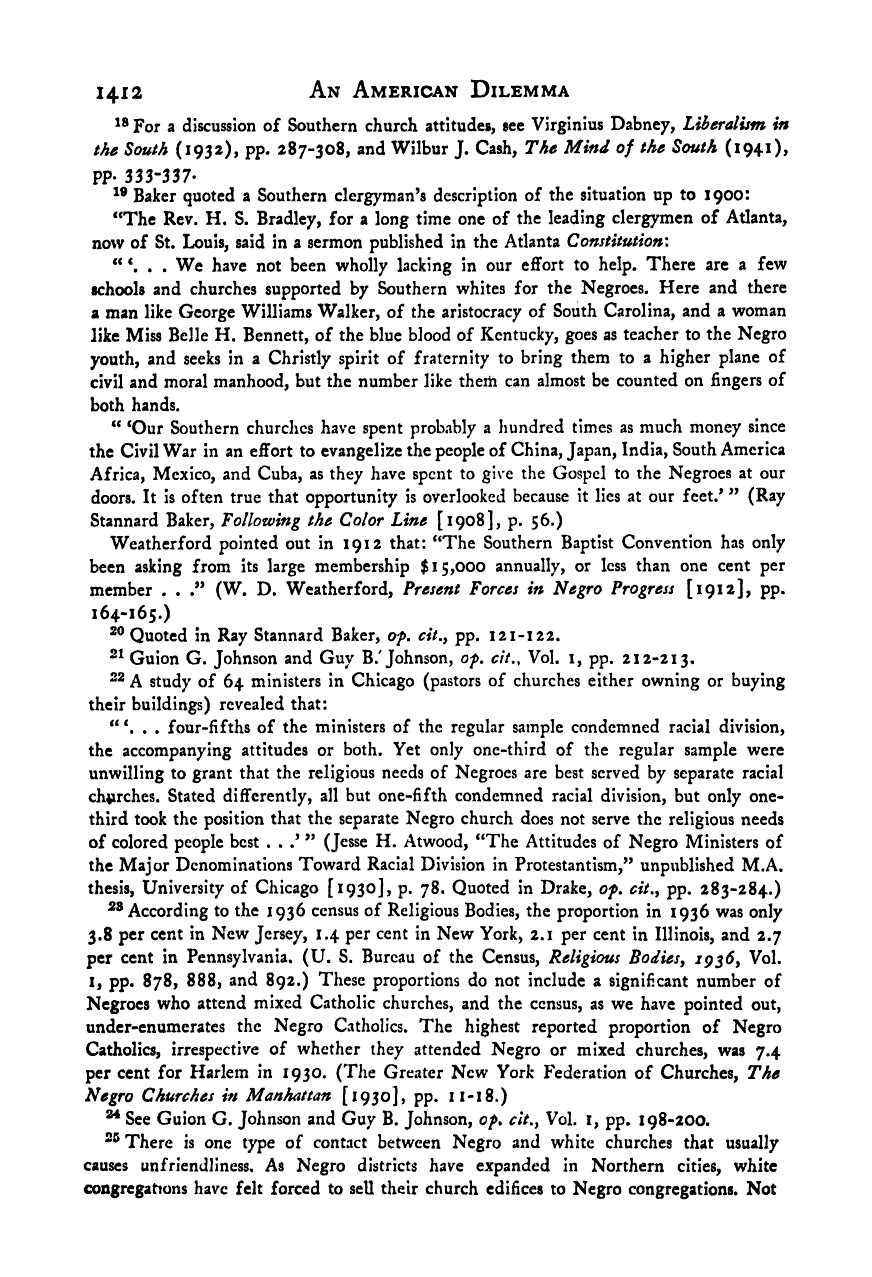
1412 An American Dilemma
For a discussion of Southern church attitudes, see Virginius Dabney, Liberalism in
the South (1932), pp. 287-308, and Wilbur J. Cash, The Mind of the South (i 940>
PP- 353-
337-
Baker quoted a Southern clergyman’s description of the situation up to 1900:
‘‘The Rev. H. S. Bradley, for a long time one of the leading clergymen of Atlanta,
now of St. Louis, said in a sermon published in the Atlanta Constitution’,
“ . We have not been wholly lacking in our effort to help. There are a few
schools and churches supported by Southern whites for the Negroes. Here and there
a man like George Williams Walker, of the aristocracy of South Carolina, and a woman
like Miss Belle H. Bennett, of the blue blood of Kentucky, goes as teacher to the Negro
youth, and seeks in a Christly spirit of fraternity to bring them to a higher plane of
civil and moral manhood, but the number like them can almost be counted on fingers of
both hands.
“ ‘Our Southern churches have spent probably a hundred times as much money since
the Civil War in an effort to evangelize the people of China, Japan, India, South America
Africa, Mexico, and Cuba, as they have spent to give the Gospel to the Negroes at our
doors. It is often true that opportunity is overlooked because it lies at our feet.’ ” (Ray
Stannard Baker, Following the Color Line [1908], p. 56.)
Weatherford pointed out in 1912 that: “The Southern Baptist Convention has only
been asking from its large membership $15,000 annually, or less than one cent per
member . .
(W. D. Weatherford, Present Forces in Negro Progress [1912], pp.
164-165.)
Quoted in Ray Stannard Baker, of, cit,, pp. 121-122.
Guion G. Johnson and Guy B.’ Johnson, of, cit„ Vol. 1, pp. 212-213.
A study of 64 ministers in Chicago (pastors of churches either owning or buying
their buildings) revealed that:
‘“. . . four-fifths of the ministers of the regular sample condemned racial division,
the accompanying attitudes or both. Yet only one-third of the regular sample were
unwilling to grant that the religious needs of Negroes are best served by separate racial
chiirches. Stated differently, all but one-fifth condemned racial division, but only one-
third took the position that the separate Negro church does not serve the religious needs
of colored people best . . ” (Jesse H. Atwood, “The Attitudes of Negro Ministers of
the Major Denominations Toward Racial Division in Protestantism,” unpublished M.A.
thesis, University of Chicago [1930], p. 78. Quoted in Drake, of, cit,y pp. 283-284.)
According to the 1936 census of Religious Bodies, the proportion in 1936 was only
3.8 per cent in New Jersey, 1.4 per cent in New York, 2.1 per cent in Illinois, and 2.7
per cent in Pennsylvania. (U. S. Bureau of the Census, Religious Bodies
y
1936, Vol.
I, pp. 878, 888, and 892.) These proportions do not include a significant number of
Negroes who attend mixed Catholic churches, and the census, as we have pointed out,
under-enumerates the Negro Catholics. The highest reported proportion of Negro
Catholics, irrespective of whether they attended Negro or mixed churches, was 7.4
per cent for Harlem in 1930. (The Greater New York F’ederation of Churches, The
Negro Churches in Manhattan [1930], pp. 11-18.)
^ See Guion G. Johnson and Guy B. Johnson, of, clt,y Vol. i, pp. 198-200.
There is one type of contact between Negro and white churches that usually
causes unfriendliness. As Negro districts have expanded in Northern cities, white
congregations have felt forced to sell their church edifices to Negro congregations. Not
<< prev. page << föreg. sida << >> nästa sida >> next page >>

