Full resolution (JPEG) - On this page / på denna sida - City of Quebec

<< prev. page << föreg. sida << >> nästa sida >> next page >>
Below is the raw OCR text
from the above scanned image.
Do you see an error? Proofread the page now!
Här nedan syns maskintolkade texten från faksimilbilden ovan.
Ser du något fel? Korrekturläs sidan nu!
This page has never been proofread. / Denna sida har aldrig korrekturlästs.
City of Quebec
The historic city of Quebec stands on a rocky promontory on the north
shore of the St. Lawrence River. The value of this strategic position was
first recognized by the Indians — and when Jacques Cartier sailed up the
River in 1535, he found an armed, Indian encampment “‘Stadacona”’ established
on the site of the present Quebec. Almost a century later, the explorer Samuel
de Champlain was to choose this rock-bastion as the capital of New France
and he built his first frail fort upon its side. Quebec remained the stronghold
of the French colony until its capture in 1759 by the English general James
Wolfe. The Plains of Abraham still mark the old battleground.
Today Quebec, with a population of 200,814, is the capital of the Province
of Quebec, and the natural resources of this province are largely responsible
for the industries of the city. The abundant supply of water power and the
expanse of forest have made pulp and paper an important industry. Recently
Anglo-Canadian Pulp and Paper Company opened what is claimed to be the
most modern pulp and paper mills in the world. Quebec possesses a wide
deep harbour and as a shipping port, is second only to Montreal in the province.
The charm of the city lies in the picturesque contrast of the old and the
new. A humming, industrial 20th-century city has grown up in an old-world !
setting, where the customs and architecture of 17th-century France still
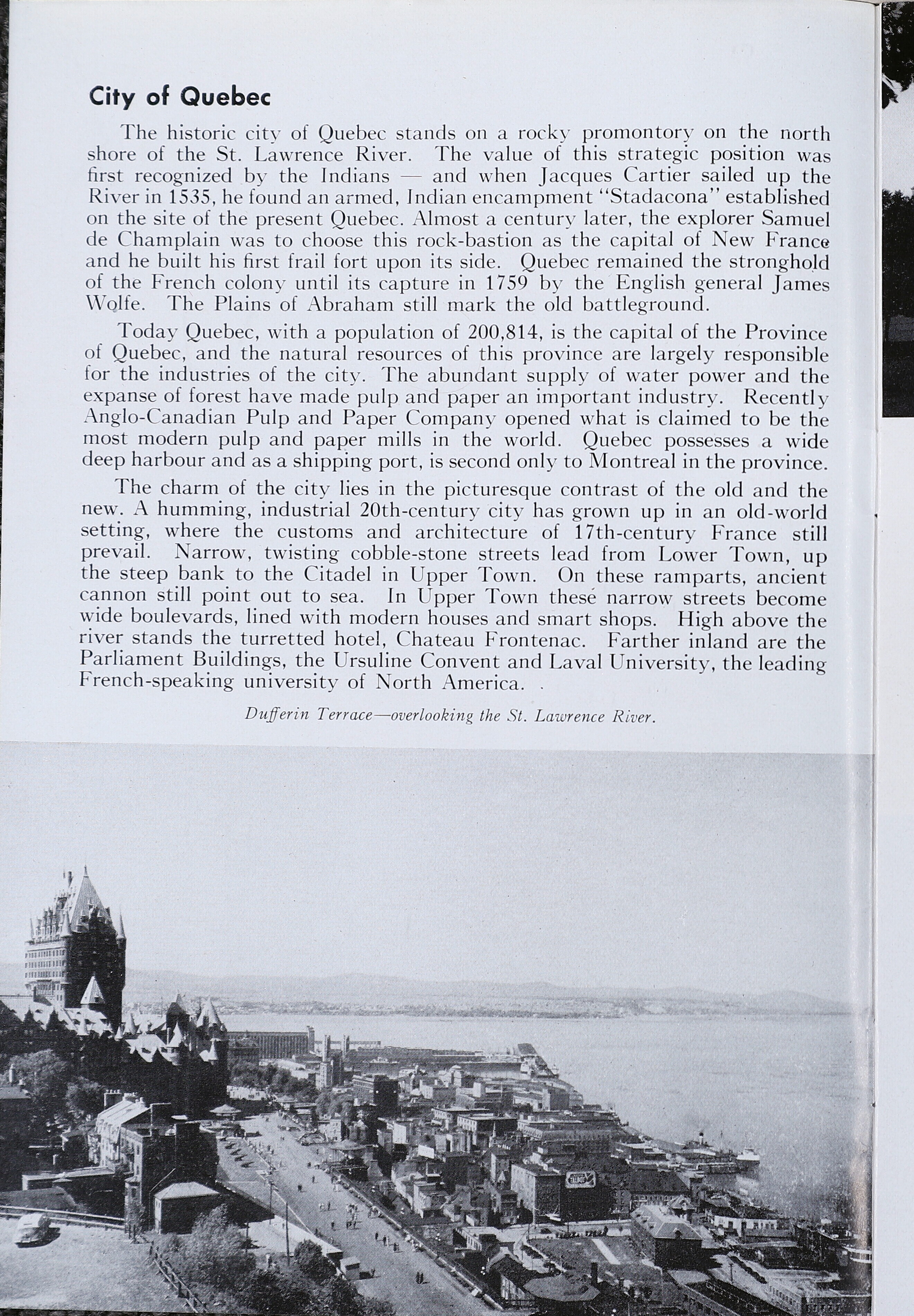
prevail. Narrow, twisting cobble-stone streets lead from Lower Town, up
the steep bank to the Citadel in Upper Town. On these ramparts, ancient
cannon still point out to sea. In Upper Town thesé narrow streets become
wide boulevards, lined with modern houses and smart shops. High above the
river stands the turretted hotel, Chateau Frontenac. Farther inland are the
Parliament Buildings, the Ursuline Convent and Laval University, the leading
French-speaking university of North America.
Dufferin Terrace—overlooking the St. Lawrence River.
ag tes
pes
MY
HA
<< prev. page << föreg. sida << >> nästa sida >> next page >>