
Full resolution (JPEG)
- On this page / på denna sida
- VII. The Church in the “Time of Freedom” and Period of Neology (1718—1811 A.D.)
<< prev. page << föreg. sida << >> nästa sida >> next page >>
Below is the raw OCR text
from the above scanned image.
Do you see an error? Proofread the page now!
Här nedan syns maskintolkade texten från faksimilbilden ovan.
Ser du något fel? Korrekturläs sidan nu!
This page has never been proofread. / Denna sida har aldrig korrekturlästs.
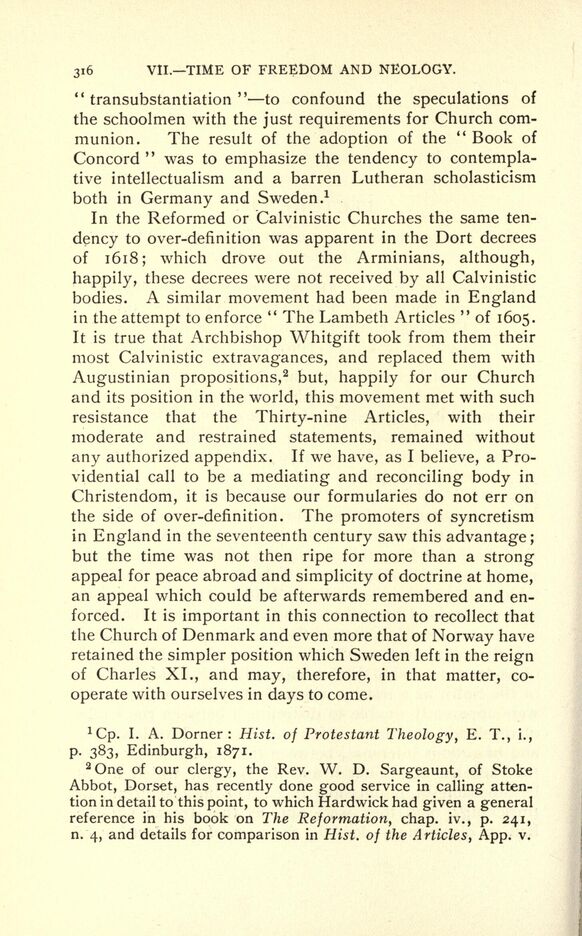
3I 6 VII. TIME OF FREEDOM AND NEOLOGY.
"
transubstantiation
"
to confound the speculations of
the schoolmen with the just requirements for Church com
munion. The result of the adoption of the
*
Book of
Concord" was to emphasize the tendency to contempla
tive intellectualism and a barren Lutheran scholasticism
both in Germany and Sweden.1
In the Reformed or Calvinistic Churches the same ten
dency to over-definition was apparent in the Dort decrees
of 1618; which drove out the Arminians, although,
happily, these decrees were not received by all Calvinistic
bodies. A similar movement had been made in England
in the attempt to enforce
"
The Lambeth Articles
"
of 1605.
It is true that Archbishop Whitgift took from them their
most Calvinistic extravagances, and replaced them with
Augustinian propositions,
2
but, happily for our Church
and its position in the world, this movement met with such
resistance that the Thirty-nine Articles, with their
moderate and restrained statements, remained without
any authorized appendix. If we have, as I believe, a Pro
vidential call to be a mediating and reconciling body in
Christendom, it is because our formularies do not err on
the side of over-definition. The promoters of syncretism
in England in the seventeenth century saw this advantage;
but the time was not then ripe for more than a strong
appeal for peace abroad and simplicity of doctrine at home,
an appeal which could be afterwards remembered and en
forced. It is important in this connection to recollect that
the Church of Denmark and even more that of Norway have
retained the simpler position which Sweden left in the reign
of Charles XL, and may, therefore, in that matter, co
operate with ourselves in days to come.
l
Cp. I. A. Dorner : Hist, of Protestant Theology, E. T., i.,
p. 383, Edinburgh, 1871.
2
One of our clergy, the Rev. W. D. Sargeaunt, of Stoke
Abbot, Dorset, has recently done good service in calling atten
tion in detail to this point, to which Hardwickhad given a general
reference in his book on The Reformation, chap, iv., p. 241,
n. 4, and details for comparison in Hist, of the Articles, App. v.
<< prev. page << föreg. sida << >> nästa sida >> next page >>
Project Runeberg, Sat Dec 9 18:38:14 2023
(aronsson)
(download)
<< Previous
Next >>
https://runeberg.org/chsweden/0338.html


