Full resolution (JPEG) - On this page / på denna sida - Mensuration - Circular zone - To compute the volume of a segment of a sphere - To find the volume of a spherical segment when the height of the segment and the diameter of the sphere are known - To find the surface of a cylinder

<< prev. page << föreg. sida << >> nästa sida >> next page >>
Below is the raw OCR text
from the above scanned image.
Do you see an error? Proofread the page now!
Här nedan syns maskintolkade texten från faksimilbilden ovan.
Ser du något fel? Korrekturläs sidan nu!
This page has never been proofread. / Denna sida har aldrig korrekturlästs.
V
MENSURATION. 203
the quotient by the width of the zone, and the product is the
area.
To Compute the Volume of a Segment of a Sphere.
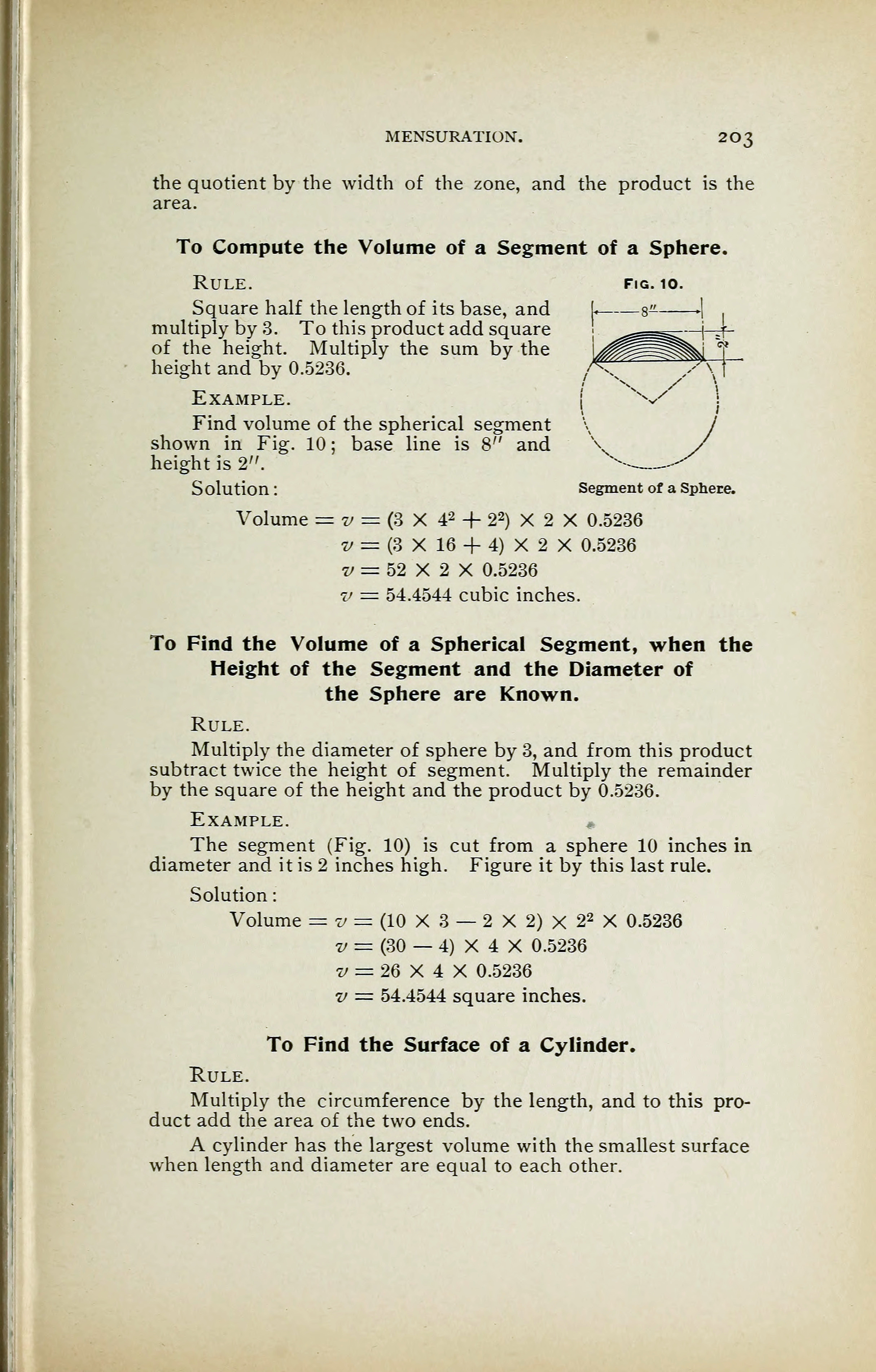
Rule. fig. 10.
Square half the length of its base, and
multiply by 3. To this product add square
of the height. Multiply the sum by the
height and by 0.5236.
Example.
Find volume of the spherical segment
shown in Fig. 10 ; base line is 8" and
height is 2".
Solution: Segment of a Sphere.
Volume = v — (3 X 42
+ 22
) X 2 X 0.5236
v — (3 X 16 4- 4) X 2 X 0.5236
v = 52 X 2 X 0.5236
v = 54.4544 cubic inches.
To Find the Volume of a Spherical Segment, when the
Height of the Segment and the Diameter of
the Sphere are Known.
Rule.
Multiply the diameter of sphere by 3, and from this product
subtract twice the height of segment. Multiply the remainder
by the square of the height and the product by 0.5236.
Example. #
The segment (Fig. 10) is cut from a sphere 10 inches in
diameter and it is 2 inches high. Figure it by this last rule.
Solution
:
Volume = v = (10 X 3 — 2 X 2) X 22
X 0.5236
v = (30 — 4) X 4 X 0.5236
v = 26 X 4 X 0.5236
v = 54.4544 square inches.
To Find the Surface of a Cylinder.
Rule.
Multiply the circumference by the length, and to this pro-
duct add the area of the two ends.
A cylinder has the largest volume with the smallest surface
when length and diameter are equal to each other.
<< prev. page << föreg. sida << >> nästa sida >> next page >>