
Full resolution (JPEG) - On this page / på denna sida - Mechanics - Acceleration due to gravity - Velocity - Height of fall
<< prev. page << föreg. sida << >> nästa sida >> next page >>
Below is the raw OCR text
from the above scanned image.
Do you see an error? Proofread the page now!
Här nedan syns maskintolkade texten från faksimilbilden ovan.
Ser du något fel? Korrekturläs sidan nu!
This page has never been proofread. / Denna sida har aldrig korrekturlästs.
MECHANICS. 277
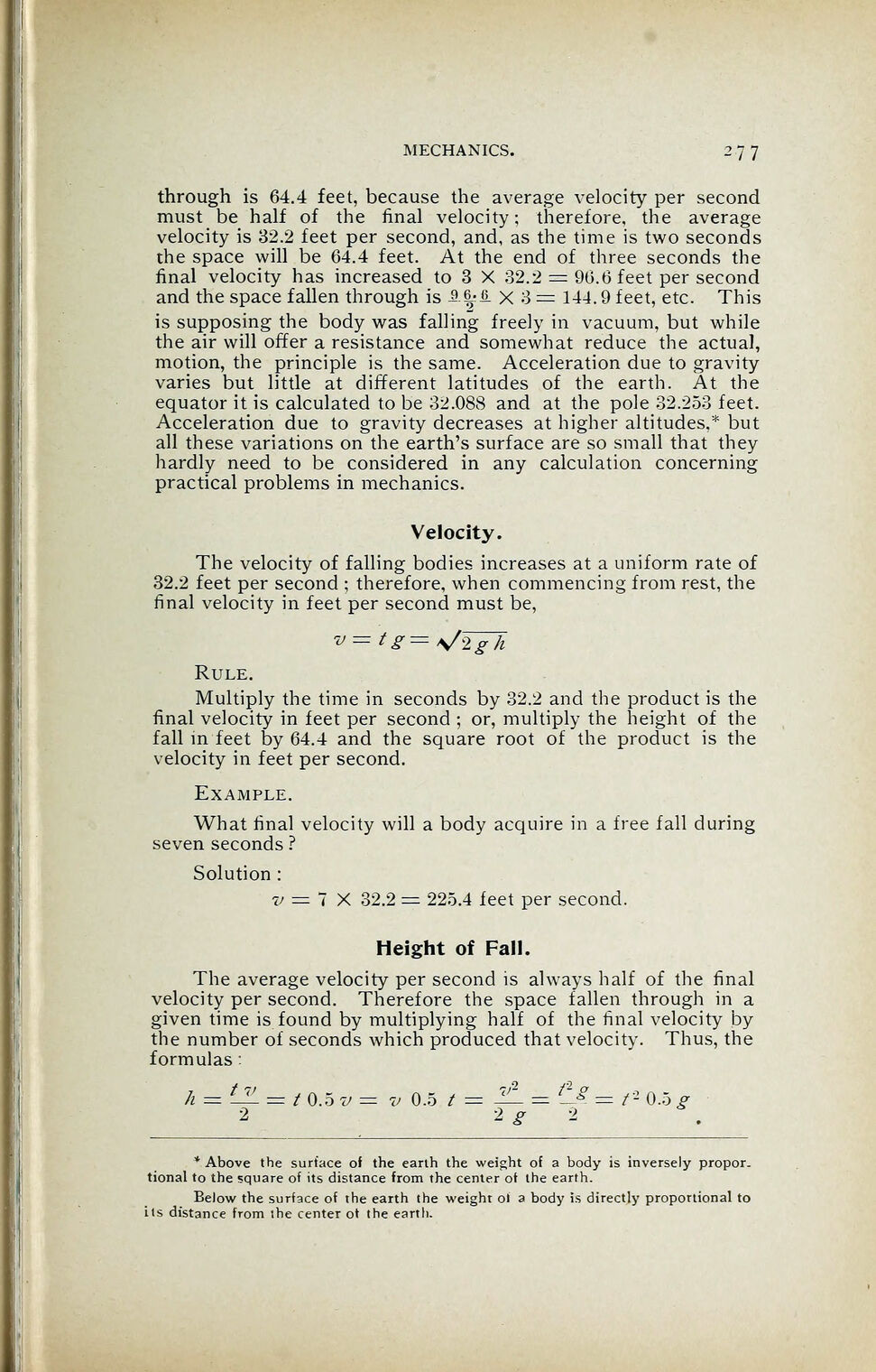
through is 64.4 feet, because the average velocity per second
must be half of the final velocity; therefore, the average
velocity is 32.2 feet per second, and, as the time is two seconds
the space will be 64.4 feet. At the end of three seconds the
final velocity has increased to 3 X 32.2 = 96.6 feet per second
and the space fallen through is $%•$- X 3 = 144. 9 feet, etc. This
is supposing the body was falling freely in vacuum, but while
the air will offer a resistance and somewhat reduce the actual,
motion, the principle is the same. Acceleration due to gravity
varies but little at different latitudes of the earth. At the
equator it is calculated to be 32.088 and at the pole 32.253 feet.
Acceleration due to gravity decreases at higher altitudes.* but
all these variations on the earth’s surface are so small that they
hardly need to be considered in any calculation concerning
practical problems in mechanics.
Velocity.
The velocity of falling bodies increases at a uniform rate of
32.2 feet per second ; therefore, when commencing from rest, the
final velocity in feet per second must be,
Rule.
Multiply the time in seconds by 32.2 and the product is the
final velocity in feet per second ; or, multiply the height of the
fall in feet by 64.4 and the square root of the product is the
velocity in feet per second.
Example.
What final velocity will a body acquire in a free fall during
seven seconds ?
Solution :
v = 1 X 32.2 = 225.4 feet per second.
Height of Fall.
The average velocity per second is always half of the final
velocity per second. Therefore the space fallen through in a
given time is found by multiplying half of the final velocity by
the number of seconds which produced that velocity. Thus, the
formulas
:
h = *JL — / 0.5 v = v 0.5 t — — — ^—t- 0.5 g
2 2 ? 2
* Above the surface of the earth the weight of a body is inversely propor.
tional to the square of its distance from the center of the earth.
Below the surface of the earth the weight of a body is directly proportional to
its distance from the center of the earth.
<< prev. page << föreg. sida << >> nästa sida >> next page >>


