
Full resolution (JPEG) - On this page / på denna sida - Mechanics - Proportions for a two-ton derrick
<< prev. page << föreg. sida << >> nästa sida >> next page >>
Below is the raw OCR text
from the above scanned image.
Do you see an error? Proofread the page now!
Här nedan syns maskintolkade texten från faksimilbilden ovan.
Ser du något fel? Korrekturläs sidan nu!
This page has never been proofread. / Denna sida har aldrig korrekturlästs.
CRANES AND DERRICKS. 325
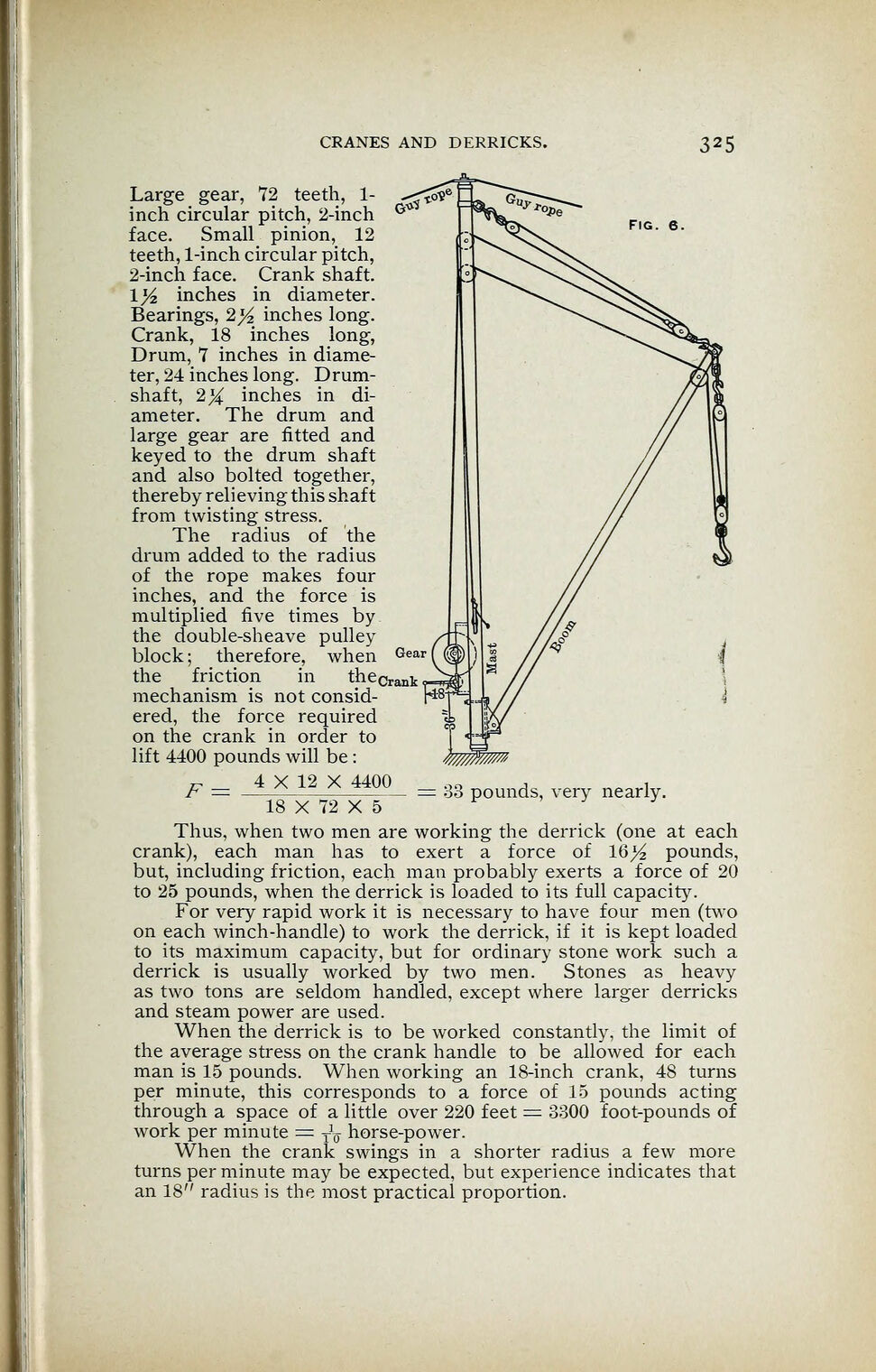
Large gear, 72 teeth, 1-
inch circular pitch, 2-inch
face. Small pinion, 12
teeth, 1-inch circular pitch,
2-inch face. Crank shaft.
\y
z inches in diameter.
Bearings, 2^ inches long.
Crank, 18 inches long,
Drum, 7 inches in diame-
ter, 24 inches long. Drum-
shaft, 2X inches in di-
ameter. The drum and
large gear are fitted and
keyed to the drum shaft
and also bolted together,
thereby relieving this shaft
from twisting stress.
The radius of the
drum added to the radius
of the rope makes four
inches, and the force is
multiplied five times by
the double-sheave pulley
block; therefore, when Gear
the friction in thecrank
mechanism is not consid-
ered, the force required
on the crank in order to
lift 4400 pounds will be
:
r, _ 4 X 12 X 4400
18 X 72 X 5
= 33 pounds, very nearly.
Thus, when two men are working the derrick (one at each
crank), each man has to exert a force of 16>^ pounds,
but, including friction, each man probably exerts a force of 20
to 25 pounds, when the derrick is loaded to its full capacity.
For very rapid work it is necessary to have four men (two
on each winch-handle) to work the derrick, if it is kept loaded
to its maximum capacity, but for ordinary stone work such a
derrick is usually worked by two men. Stones as heavy
as two tons are seldom handled, except where larger derricks
and steam power are used.
When the derrick is to be worked constantly, the limit of
the average stress on the crank handle to be allowed for each
man is 15 pounds. When working an 18-inch crank, 48 turns
per minute, this corresponds to a force of 15 pounds acting
through a space of a little over 220 feet = 3300 foot-pounds of
work per minute = yV horse-power.
When the crank swings in a shorter radius a few more
turns per minute may be expected, but experience indicates that
an 18" radius is the most practical proportion.
<< prev. page << föreg. sida << >> nästa sida >> next page >>


