Full resolution (JPEG) - On this page / på denna sida - Notes on Hydraulics - Pressure of fluid in a vessel - Velocity of efflux

<< prev. page << föreg. sida << >> nästa sida >> next page >>
Below is the raw OCR text
from the above scanned image.
Do you see an error? Proofread the page now!
Här nedan syns maskintolkade texten från faksimilbilden ovan.
Ser du något fel? Korrekturläs sidan nu!
This page has never been proofread. / Denna sida har aldrig korrekturlästs.
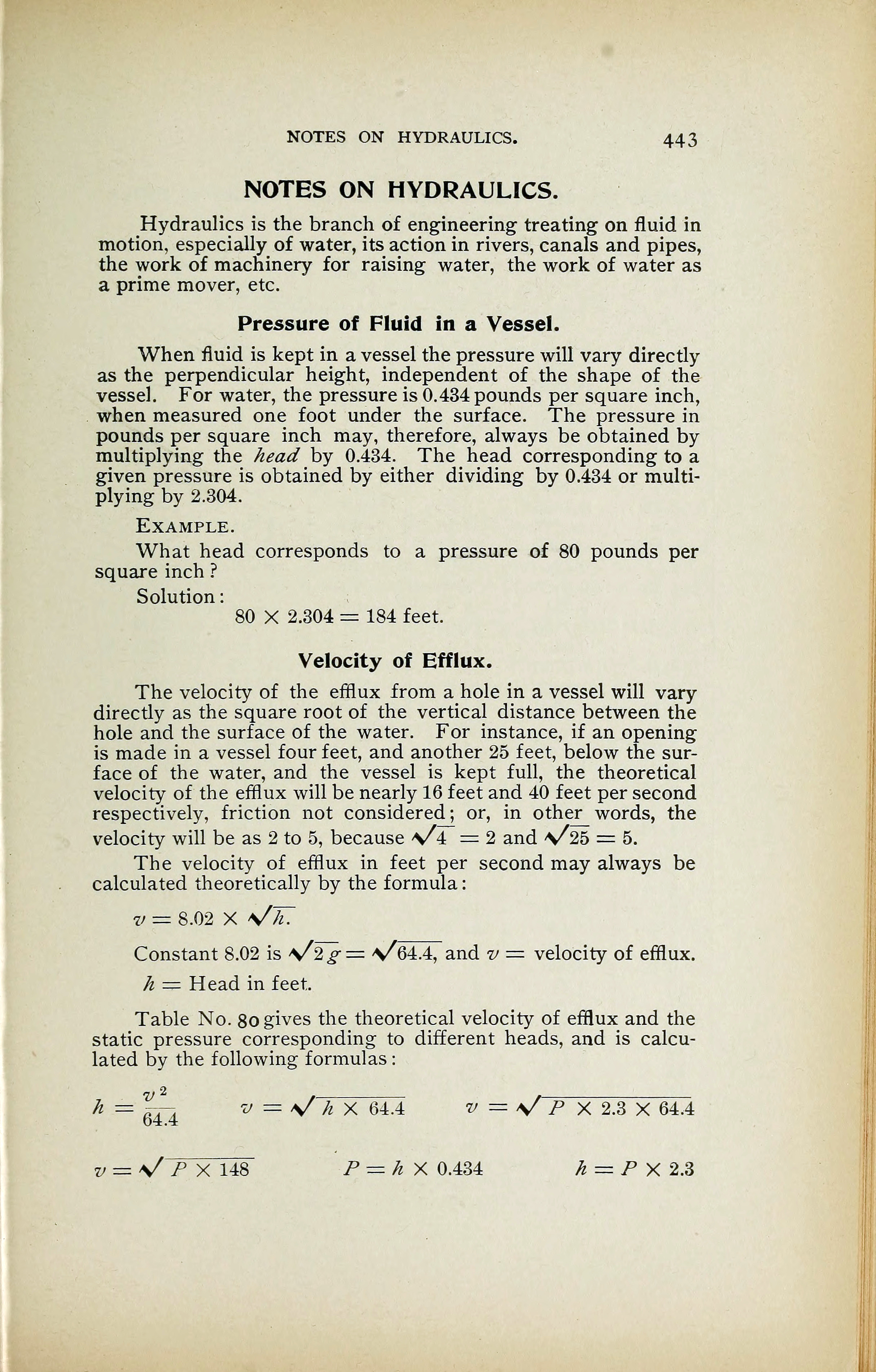
NOTES ON HYDRAULICS. 443
NOTES ON HYDRAULICS.
Hydraulics is the branch of engineering treating on fluid in
motion, especially of water, its action in rivers, canals and pipes,
the work of machinery for raising water, the work of water as
a prime mover, etc.
Pressure of Fluid in a Vessel.
When fluid is kept in a vessel the pressure will vary directly
as the perpendicular height, independent of the shape of the
vessel. For water, the pressure is 0.434 pounds per square inch,
when measured one foot under the surface. The pressure in
pounds per square inch may, therefore, always be obtained by
multiplying the head by 0.434. The head corresponding to a
given pressure is obtained by either dividing by 0.434 or multi-
plying by 2.304.
Example.
What head corresponds to a pressure of 80 pounds per
square inch ?
Solution
:
80 X 2.304 = 184 feet.
Velocity of Efflux.
The velocity of the efflux from a hole in a vessel will vary
directly as the square root of the vertical distance between the
hole and the surface of the water. For instance, if an opening
is made in a vessel four feet, and another 25 feet, below the sur-
face of the water, and the vessel is kept full, the theoretical
velocity of the efflux will be nearly 16 feet and 40 feet per second
respectively, friction not considered; or, in other words, the
velocity will be as 2 to 5, because \^4 = 2 and \/25 — 5.
The velocity of efflux in feet per second may always be
calculated theoretically by the formula
:
v — 8.02 X s/h~.
Constant 8.02 is \^2g— V64.4, and v = velocity of efflux.
h = Head in feet.
Table No. 8o gives the theoretical velocity of efflux and the
static pressure corresponding to different heads, and is calcu-
lated by the following formulas :
h = V
-— v — s/ h X 64.4 v = V P X 2.3 X 64,4
o4.4
v = V P X 148 P — h X 0.434 h — P X 2.Z
<< prev. page << föreg. sida << >> nästa sida >> next page >>