Full resolution (JPEG)
- On this page / på denna sida
- Sidor ...

<< prev. page << föreg. sida << >> nästa sida >> next page >>
Below is the raw OCR text
from the above scanned image.
Do you see an error? Proofread the page now!
Här nedan syns maskintolkade texten från faksimilbilden ovan.
Ser du något fel? Korrekturläs sidan nu!
This page has never been proofread.
/ Denna sida har aldrig korrekturlästs.
Belyst af O. Jespersen. 95
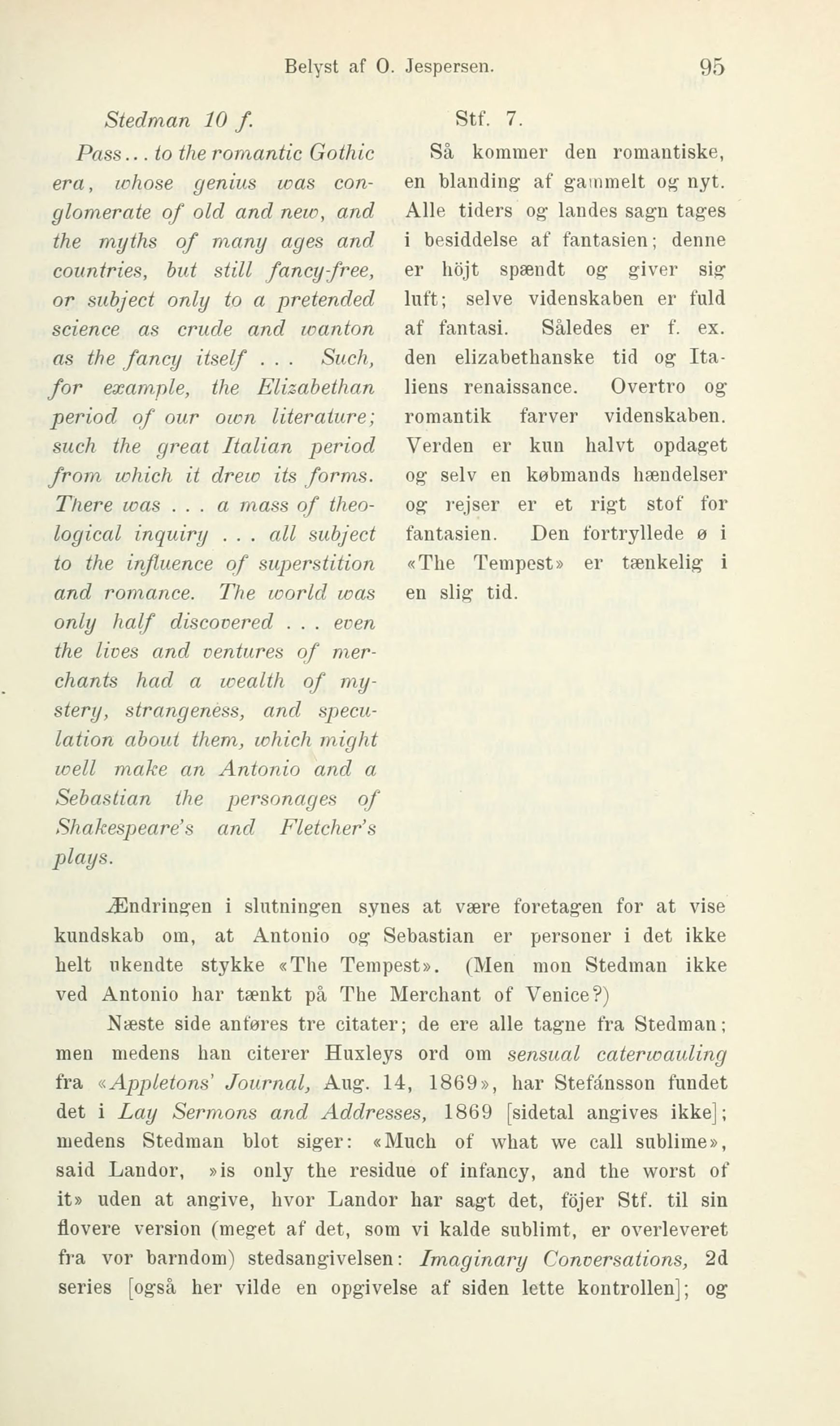
Stedman 10 f.
Pass..….to the romantic Gothic
era, whose genius was
conglomerate of old and new, and
the myths of many ages and
countries, but still fancy-free,
or subject only to a pretended
science as crude and wanton
as the, fancy itself --- Such,
for example, the Elizabethan
period of our own literature;
such the great Italian period
from which it drew its forms.
There was ... a mass of
theological inquiry ... all subject
to the influence of superstition
and romance. The world was
only half discovered ... even
the lives and ventures of
merchants had a wealth of
mystery, strangenėss, and
speculation about them, which might
well make an Antonio and a
Sebastian the personages of
Shakespeare's and Fletcher’s
plays.
Stf. 7.
Så kommer den romantiske,
en blanding af gammelt og nyt.
Alle tiders og landes sagn tages
i besiddelse af fantasien; denne
er höjt spændt og
luft; selve videnskaben er fuld
af fantasi. Således er f. ex.
elizabethanske tid og
Italiens renaissance.
giver sig
den
Overtro og
romantik farver videnskaben.
Verden er kun halvt opdaget
og selv en købmands hændelser
og rejser er et rigt stof for
fantasien. Den fortryllede ø i
«The Tempest» er tænkelig i
en slig tid.
Ændringen i slutningen synes at være foretagen for at vise
kundskab om,
at Antonio og Sebastian er personer i det ikke
helt ukendte stykke «The Tempest».
(Men mon Stedman ikke
ved Antonio har tænkt på The Merchant of Venice?)
Næste side anføres tre citater; de ere alle tagne fra Stedman;
men medens han citerer Huxleys ord om sensual caterwauling
fra «Appletons’ Journal, Aug. 14, 1869», har Stefánsson fundet
det i Lay Sermons and Addresses, 1869 [sidetal angives ikke];
medens Stedman blot siger: «Much of what we call sublime»,
said Landor, »is only the residue of infancy, and the worst of
it» uden at angive, hvor Landor har sagt det, föjer Stf. til sin
flovere version (meget af det, som vi kalde sublimt, er overleveret
fra vor barndom) stedsangivelsen: /maginary Conversations, 2d
series [også her vilde en opgivelse af siden lette kontrollen]; og
<< prev. page << föreg. sida << >> nästa sida >> next page >>
Project Runeberg, Tue Jun 16 13:58:03 2026
(www-data)
(download)
<< Previous
Next >>
https://runeberg.org/nordfilol/3r1/0107.html