Full resolution (JPEG)
- On this page / på denna sida
- Sidor ...

<< prev. page << föreg. sida << >> nästa sida >> next page >>
Below is the raw OCR text
from the above scanned image.
Do you see an error? Proofread the page now!
Här nedan syns maskintolkade texten från faksimilbilden ovan.
Ser du något fel? Korrekturläs sidan nu!
This page has never been proofread.
/ Denna sida har aldrig korrekturlästs.
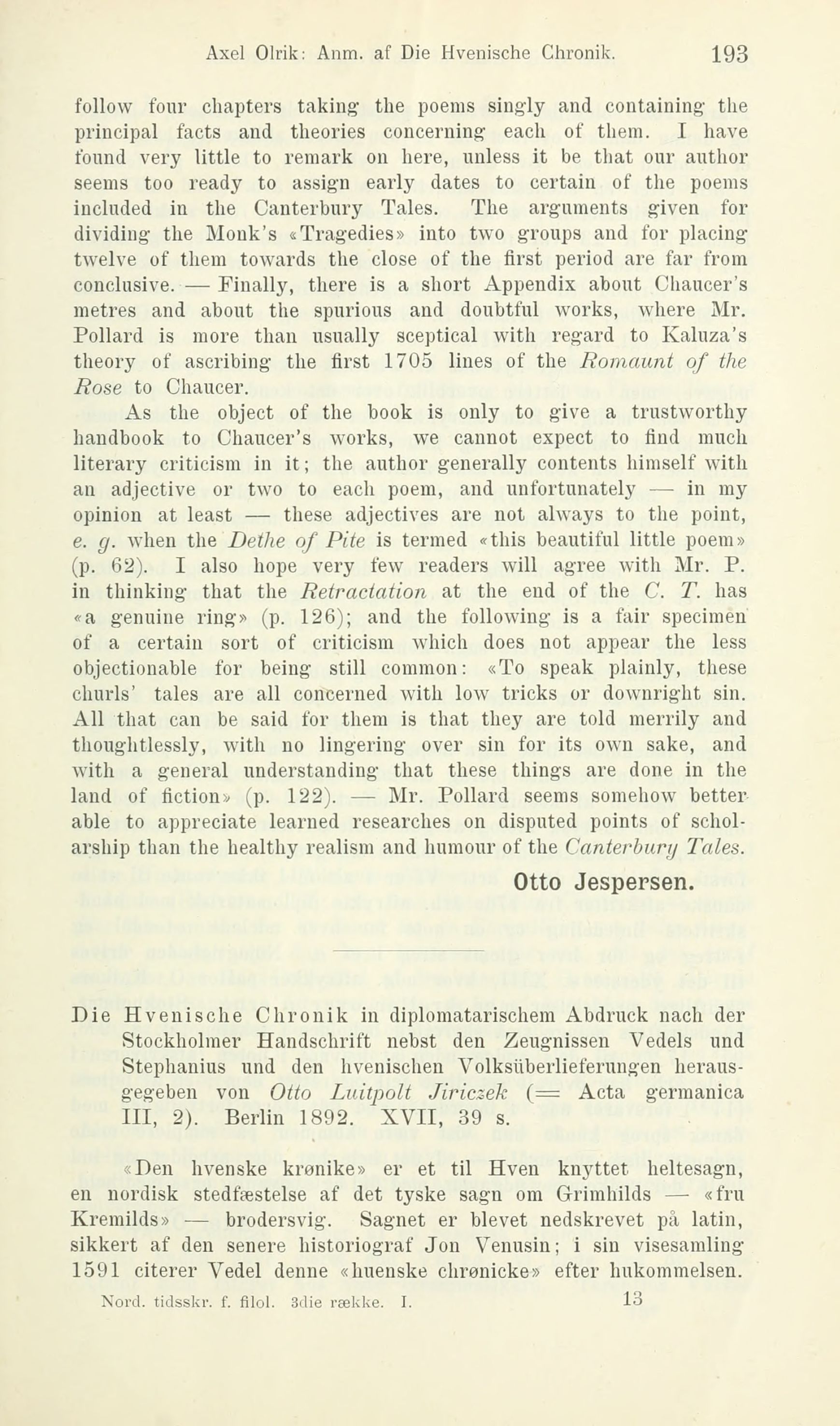
Axel Olrik: Anm. af Die Hvenische Chronik. 193
follow four chapters taking the poems singly and containing the
principal facts and theories concerning each of them. I have
tťound very little to remark on here, unless it be that our author
seems too ready to assign early dates to certain of the poems
included in the Canterbury Tales. The arguments given for
dividing the Monk’s «Tragedies» into two groups and for placing
twelve of them towards the close of the first period are far from
conclusive. — Finally, there is a short Appendix about Chaucer’s
metres and about the spurious and doubtful works, where Mr.
Pollard is more than usually sceptical with regard to Kaluza’s
theory of ascribing the first 1705 lines of the Romaunt of the
Rose to Chaucer.
As the object of the book is only to give a trustworthy
handbook to Chaucer’s works, we cannot expect to find much
literary criticism in it; the author generally contents himself with
an adjective or two to each poem, and unfortunately — in my
opinion at least — these adjectives are not always to the point,
e. g. When the Dethe of Pite is termed «this beautiful little poem»
(p. 609). I also hope. very few readers will agree with Mr. P.
in thinking that the Reftractation at the end of the C. 7. has
«a genuine ring» (p. 126); and the following is a fair specimen
of a certain sort of criticism which does not appear the less
objectionable for being still common: «To speak plainly, these
churls’ tales are all concerned with low tricks or downright sin.
All that can be said for them is that they are told merrily and
thoughtlessly, with no lingering over sin for its own sake, and
with a general understanding that these things are done in the
land of fiction» (p. 122). — Mr. Pollard seems somehow better
able to appreciate learned researches on disputed points of
scholarship than the healthy realism and humour of the Canterbury Tales.
Otto Jespersen.
Die Hvenische Chronik in diplomatarischem Abdruck nach der
Stockholmer Handschrift nebst den Zeugnissen Vedels und
Stephanius und den hvyenischen Volksüberlieferungen
herausgegeben von Otto Luitpolt Jiriczek (= Acta germanica
III, 2). Berlin 1892. XVII, 39 s.
«Den hvenske krønike» er et til Hven knyttet heltesagn,
en nordisk stedfæstelse af det tyske sagn om Grimhilds — «fru
Kremilds» — brodersvig. Sagnet er blevet nedskrevet på latin,
sikkert af den senere historiograf Jon Venusin; i sin visesamling
1591 citerer Vedel denne «huenske chrønicke» efter hukommelsen.
Nord. tidsskr. f. filol. 3die række. I. 13
<< prev. page << föreg. sida << >> nästa sida >> next page >>
Project Runeberg, Tue Jun 16 13:58:03 2026
(www-data)
(download)
<< Previous
Next >>
https://runeberg.org/nordfilol/3r1/0205.html