Full resolution (JPEG)
- On this page / på denna sida
- Sidor ...
<< prev. page << föreg. sida << >> nästa sida >> next page >>
Below is the raw OCR text
from the above scanned image.
Do you see an error? Proofread the page now!
Här nedan syns maskintolkade texten från faksimilbilden ovan.
Ser du något fel? Korrekturläs sidan nu!
This page has never been proofread.
/ Denna sida har aldrig korrekturlästs.
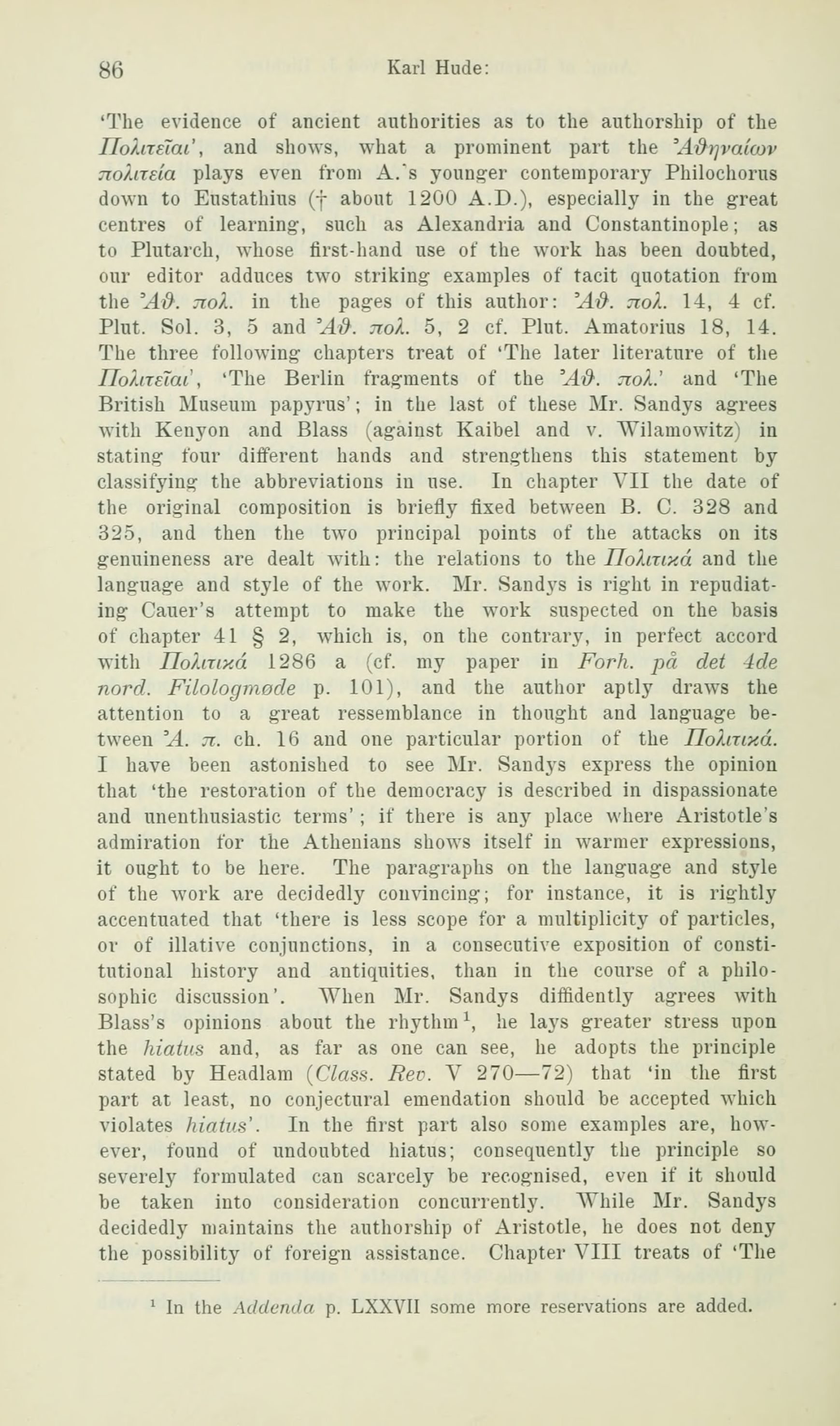
86 Karl Hude:
“The evidence of ancient authorities as to the authorship of the
Πολιτεῖαι᾽, and shows, what a prominent part the ᾿4ϑηναίων
πολιτεία plays even from A.s younger contemporary Philochorus
down to Eustathius (f about 1200 A.D.), especially in the great
centres of learning, such as Alexandria and Constantinople; as
to Plutarch, whose first-hand use of the work has been doubted,
our editor adduces two striking examples of tacit quotation from
the 4. πολ. in the pages of this author: 40. πολ. 14, 4 οἵ.
Plut. Sol. 3, 5 and 249. πολ. 5, 2 cf. Plut Amatorius 18, 14.
The three following chapters treat of ‘The later literature of the
]Πολιτεῖαι, “The Berlin fragments of the 249. πολ. and ‘The
British Museum papyrus’; in the last of these Mr. Sandys agrees
with Kenyon and Blass (against Kaibel and v. Wilamowitz) in
stating four different hands and strengthens this statement by
classifying the abbreviations in use. In chapter VII the date of
the original composition is briefly fixed between B. C. 328 and
325, and then the two principal points of the attacks on its
genuineness are dealt with: the relations to the Π]ολιτικά and the
language and style of the work. Mr. Sandys is right in
repudiating Cauer’s attempt to make the work suspected on the basis
of chapter 41 § 2, which is, on the contrary, in perfect accord
with Joli 1286 a (cf. my paper in Forh. på det 4de
nord. Filologmøde p. 101), and the author aptly draws the
attention to a great ressemblance in thought and language
between 4. π. ch. 16 and one particular portion of the Π]|ολιτικά.
I have been astonished to see Mr. Sandys express the opinion
that ‘the restoration of the democracy is described in dispassionate
and unenthusiastic terms’; if there is any place where Aristotle’s
admiration for the Athenians shows itself in warmer expressions,
it ought to be here. The paragraphs on the language and style
of the work are decidedly convincing; for instance, it is rightly
accentuated that ‘there is less scope for a multiplicity of particles,
οὐ of illative conjunctions, in a consecutive exposition of
constitutional history and antiquities, than in the course of a
philosophie discussion’. When Mr. Sandys diffidently agrees with
Blass’s opinions about the rhythm’, he lays greater stress upon
the μίας and, as far as one can see, he adopts the principle
stated by Headlam (Class. Rev. V 2700—72) that ‘in the first
part at least, no conjectural emendation should be accepted which
violates iatus’. In the first part also some examples are,
however, found of undoubted hiatus; consequently the principle so
severely formulated can scarcely be recognised, even if it should
be taken into consideration concurrently. While Mr. Sandys
decidedly maintains the authorship of Aristotle, he does not deny
the possibility of foreign assistance. Chapter VIII treats of ‘The
1 In the Addenda p. LXXVII some more reservations are added.
<< prev. page << föreg. sida << >> nästa sida >> next page >>
Project Runeberg, Tue Jun 16 15:33:36 2026
(www-data)
(download)
<< Previous
Next >>
https://runeberg.org/nordfilol/3r2/0098.html