
Full resolution (TIFF) - On this page / på denna sida - Häfte 9 - Rudolv Körner: Om objektivitet i historiska läroböcker
<< prev. page << föreg. sida << >> nästa sida >> next page >>
Below is the raw OCR text
from the above scanned image.
Do you see an error? Proofread the page now!
Här nedan syns maskintolkade texten från faksimilbilden ovan.
Ser du något fel? Korrekturläs sidan nu!
This page has never been proofread. / Denna sida har aldrig korrekturlästs.
OM OBJEKTIVITET I HISTORISKA LÄROBÖCKER 259
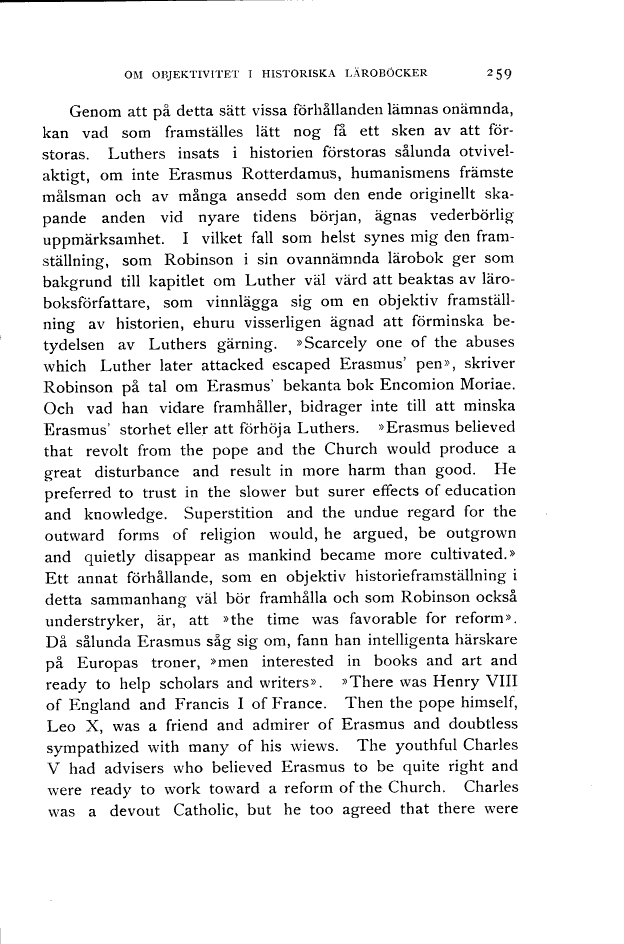
Genom att på detta sätt vissa förhållanden lämnas onämnda,
kan vad som framställes lätt nog få ett sken av att
förstoras. Luthers insats i historien förstoras sålunda
otvivelaktigt, om inte Erasmus Rotterdamus, humanismens främste
målsman och av många ansedd som den ende originellt
skapande anden vid nyare tidens början, ägnas vederbörlig
uppmärksamhet. I vilket fall som helst synes mig den
framställning, som Robinson i sin ovannämnda lärobok ger som
bakgrund till kapitlet om Luther väl värd att beaktas av
läroboksförfattare, som vinnlägga sig om en objektiv
framställning av historien, ehuru visserligen ägnad att förminska
betydelsen av Luthers gärning. »Scarcely one of the abuses
which Luther låter attacked escaped Erasmus’ pen», skriver
Robinson på tal om Erasmus’ bekanta bok Encomion Moriae.
Och vad han vidare framhåller, bidrager inte till att minska
Erasmus’ storhet eller att förhöja Luthers. »Erasmus believed
that revolt from the pope and the Church would produce a
great disturbance and resuit in more harm than good. He
preferred to trust in the slower but surer effects of éducation
and knowledge. Superstition and the undue regard for the
outward forms of religion would, he argued, be outgrown
and quietly disappear as mankind became more cultivated.»
Ett annat förhållande, som en objektiv historieframställning i
detta sammanhang väl bör framhålla och som Robinson också
understryker, är, att »the time was favorable for reform».
Då sålunda Erasmus såg sig om, fann han intelligenta härskare
på Europas troner, »men interested in books and art and
ready to help scholars and writers». »There was Henry VIII
of England and Francis I of France. Then the pope himself,
Leo X, was a friend and admirer of Erasmus and doubtless
sympathized with many of his wiews. The youthful Charles
V had advisers who believed Erasmus to be quite right and
were ready to work to ward a reform of the Church. Charles
was a devout Catholic, but he too agreed that there were
<< prev. page << föreg. sida << >> nästa sida >> next page >>

