Full resolution (JPEG) - On this page / på denna sida - XIV. Urine - V. Casual Urinary Constituents
<< prev. page << föreg. sida << >> nästa sida >> next page >>
Below is the raw OCR text
from the above scanned image.
Do you see an error? Proofread the page now!
Här nedan syns maskintolkade texten från faksimilbilden ovan.
Ser du något fel? Korrekturläs sidan nu!
This page has never been proofread. / Denna sida har aldrig korrekturlästs.
778 UEINE.
amyl alcohol yielded relatively large quantities. Secondary alcohols
produced conjugated glucuronic acids, and indeed to a greater .extent than
the primary alcohols, especially in rabbits. The ketones are reduced in
part into secondary alcohols and are partly excreted as the conjugated
acid. This could be shown for acetone with rabbits but not with dogs.
The homo- and heterocyclic compounds pass, as far as is known,
into the urine as such, or after a previous partial oxidation or synthesis
with other bodies, and appear as so-called aromatic compounds. This
applies at least to foreign substances that are introduced into the body.
The fact that benzene may be oxidized outside of the body into carbon
dioxide, oxalic acid, and volatile fatty acids has been known for a long
time; and as in these cases a rupture of the benzene ring must take place,
so also, it must be admitted, when aromatic substances undergo a com-
bustion in the animal body, a splitting of the benzene nucleus with the
formation of fatty bodies must be the result. If this does not occur, then
the benzene nucleus is eliminated with the urine as an aromatic compound
of one kind or another. The manner in which this benzene ring is opened
is not known. Still Jaff£ l
has detected muconic acid in the urine of
dogs and rabbits which had been fed for a long time with benzene, and
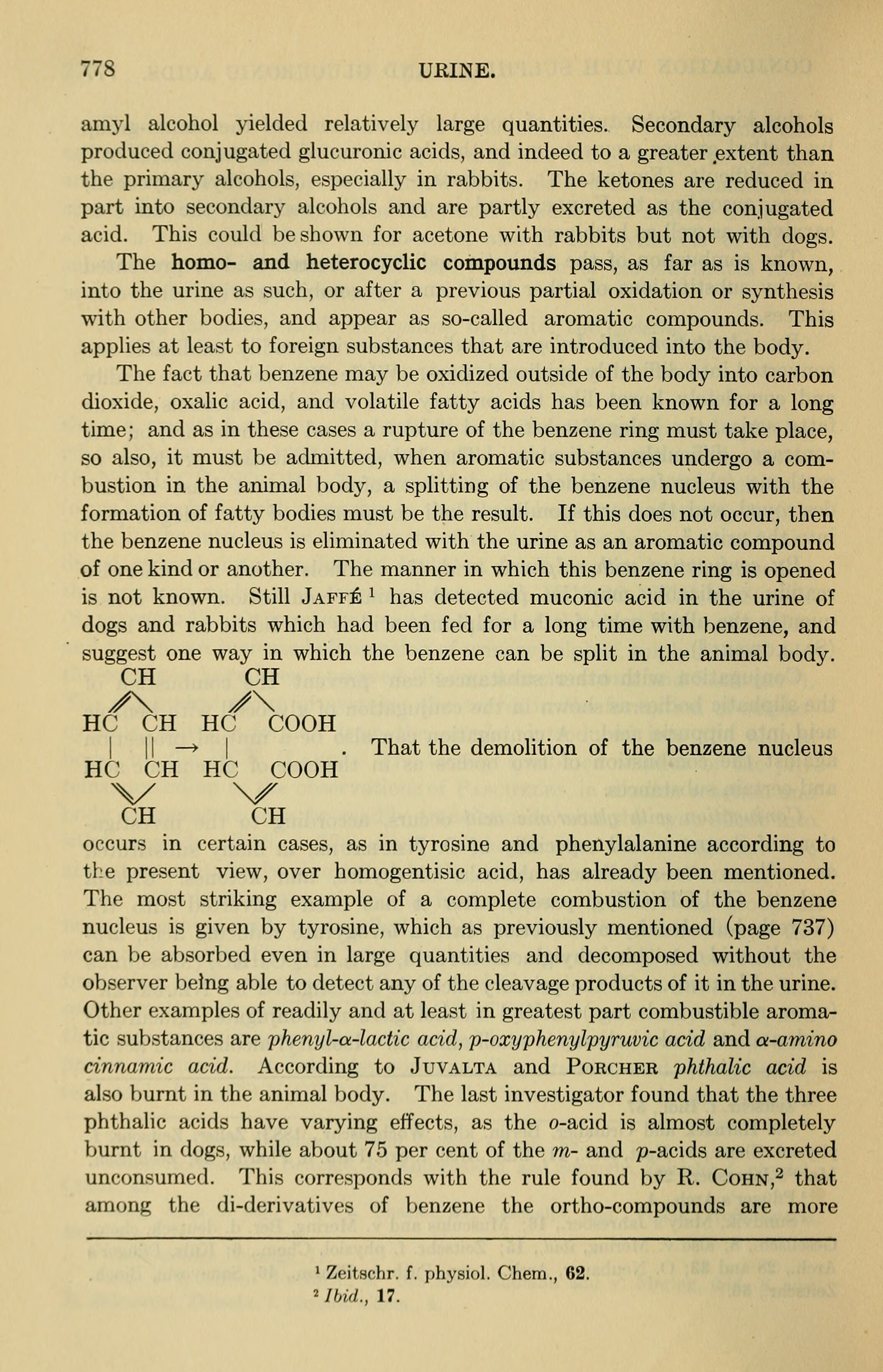
suggest one way in which the benzene can be split in the animal body.
CH CH
•\ y\
HC CH HC COOH
—
<< prev. page << föreg. sida << >> nästa sida >> next page >>