Full resolution (JPEG) - On this page / på denna sida - Sidor ...

<< prev. page << föreg. sida << >> nästa sida >> next page >>
Below is the raw OCR text
from the above scanned image.
Do you see an error? Proofread the page now!
Här nedan syns maskintolkade texten från faksimilbilden ovan.
Ser du något fel? Korrekturläs sidan nu!
This page has never been proofread. / Denna sida har aldrig korrekturlästs.
330
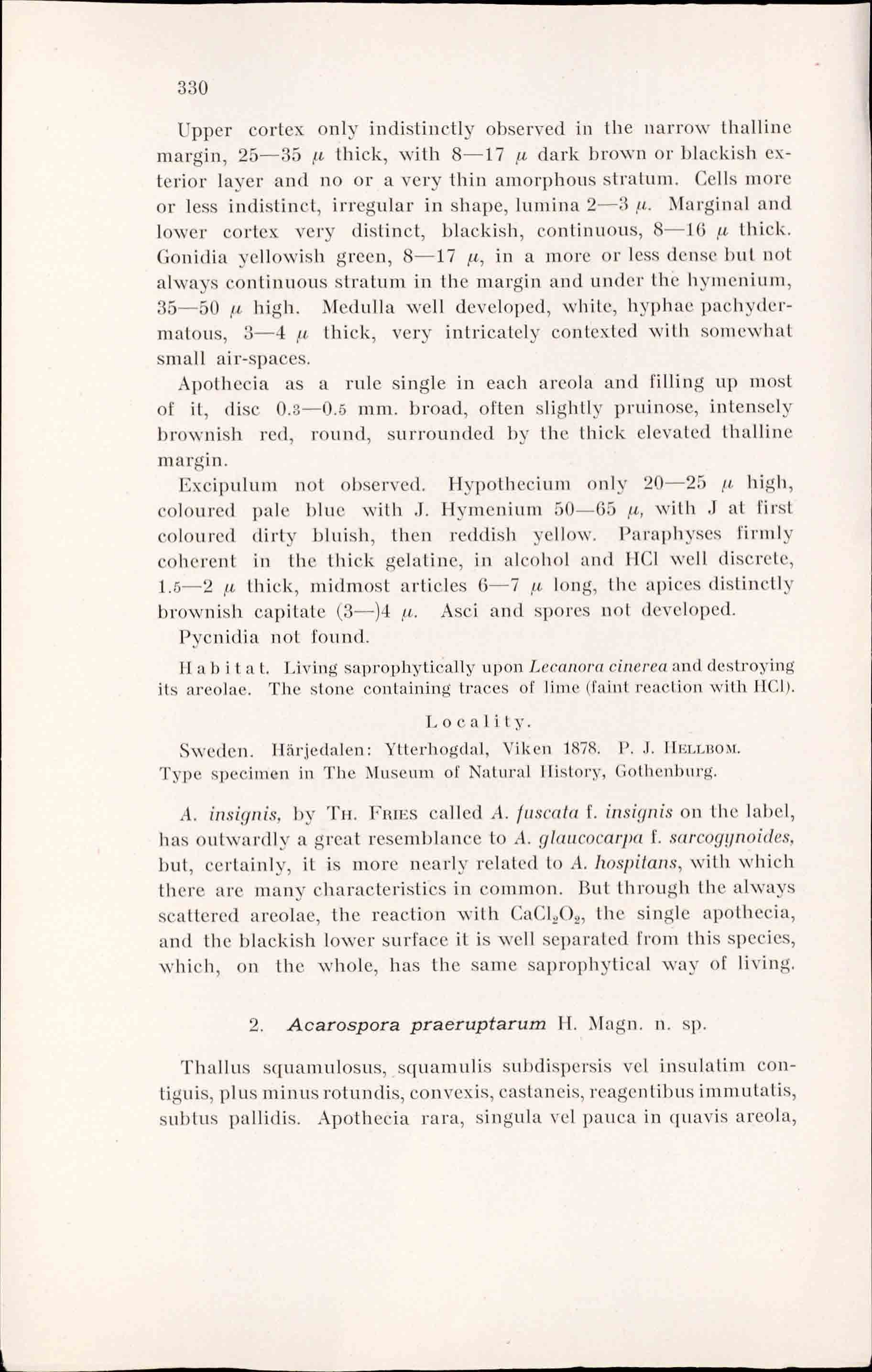
Upper cortex only indistinetly observed in the narrow thalline
margin, 25—35 u thick, with 8—17 u dark brown or blackish ex-
terior layer and no or a very thin amorphous stratum, Cells more
or less indistinct, irregular in shape, lumina 2—3 u. Marginal and
lower cortex very distinct, blackish, continuous, 8—16 w thick.
Gonidia yellowish green, 8—17 u, in a more or less dense but not
always continuous stratum in the margin and under the hymenium,
35—50 u high. Medulla well developed, white, hyphae pachyder-
matous, 3—4 u thick, very intricately contexted with somewhat
small air-spaces.
Apothecia as a rule single in each areola and filling up most
of it, disc 0.3—0.5 mm. broad, often slightly pruinose, intensely
brownish red, round, surrounded by the thick elevated thalline
margin.
Exeipulum not observed. Hypothecium only 20—25 w high,
coloured pale blue with J. Hymenium 50—65 u, with J at first
coloured dirty bluish, then reddish yellow. Paraphyses firmly
coherent in the thick gelatine, in alcohol and HCI well discrete,
1.5—2 u thick, midmost articles 6—7 u long, the apices distinctly
brownish capitate (3—)4 u. Asci and spores not developed.
Pyenidia not found.
Habitat, Living saprophytically upon Lecanora cinerea and destroying
its areolae. The stone containing traces of lime (faint reaction with ICI).
Logality.
Sweden. Härjedalen: Ytterhogdal, Viken 1878. P. J. HELLBOM.
Type specimen in The Museum of Natural History, Gothenburg.
A. insignis, by Tu. Fries called A. fuscata f. insignis on the label,
has outwardly a great resemblance to A. glaucocarpa FE. sarcogynoides,
but, certainly, it is more nearly related to A. hospitans, with which
there are many characteristics in common. But through the always
scattered areolae, the reaction with CaCl,O,, the single apothecia,
and the blackish lower surface it is well separated from this species,
which, on the whole, has the same saprophytical way of living.
2. Acarospora praeruptarum H. Magn. n. sp.
8 I
Thallus squamulosus, squamulis subdispersis vel insulatim con-
tiguis, plus minus rotundis, convexis, caslaneis, reagentibus immutatis,
subtus pallidis. Apothecia rara, singula vel pauca in quavis areola,
<< prev. page << föreg. sida << >> nästa sida >> next page >>