Full resolution (JPEG) - On this page / på denna sida - Sidor ...

<< prev. page << föreg. sida << >> nästa sida >> next page >>
Below is the raw OCR text
from the above scanned image.
Do you see an error? Proofread the page now!
Här nedan syns maskintolkade texten från faksimilbilden ovan.
Ser du något fel? Korrekturläs sidan nu!
This page has never been proofread. / Denna sida har aldrig korrekturlästs.
356
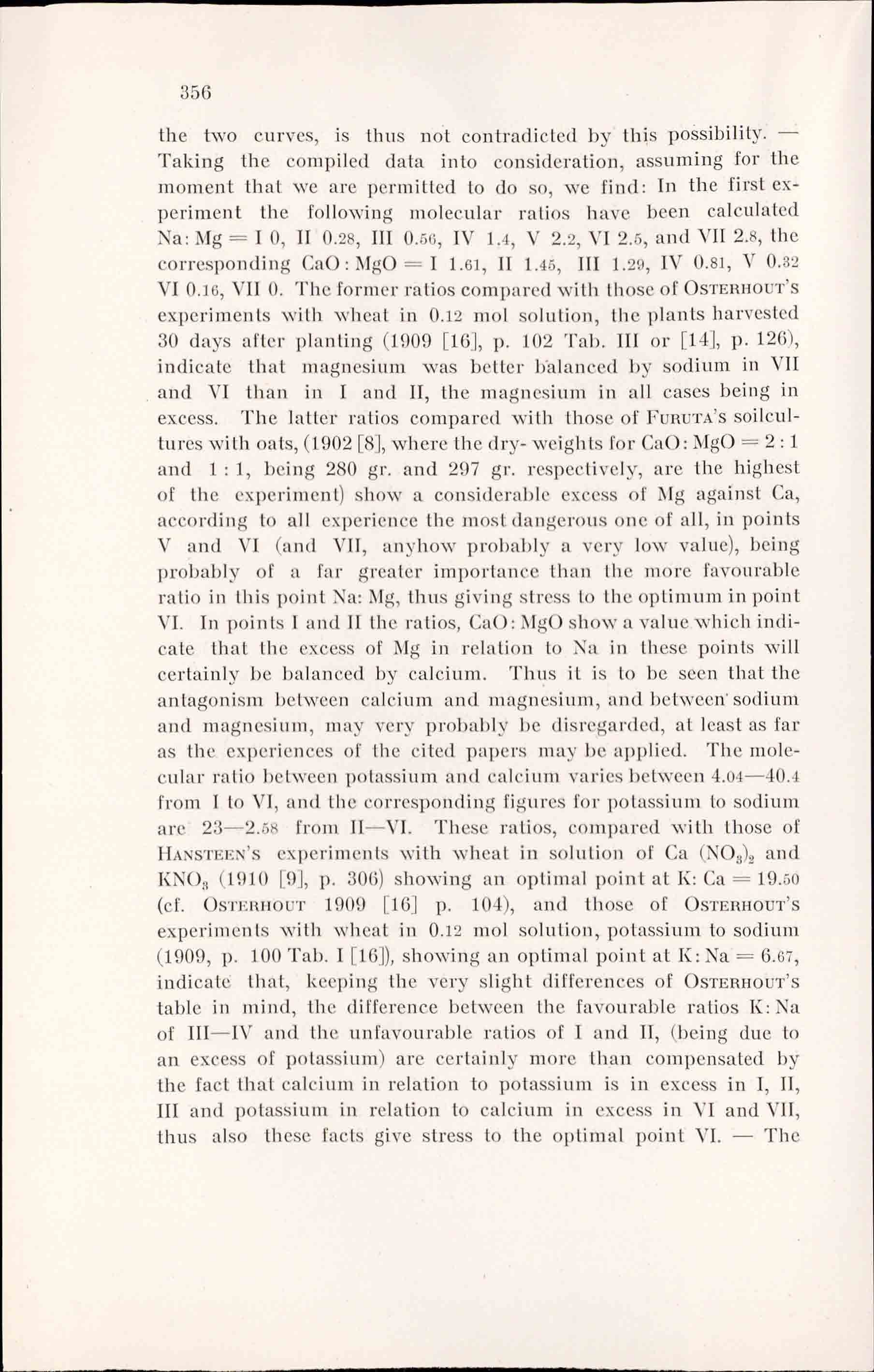
the two curves, is thus not contradicted by this possibility. —
Taking the compiled data into consideration, assuming for the
moment that we are permitted to do so, we find: In the first ex-
periment the following molecular ratios have been calculated
Na: Mg = I 0, II 0.28, III 0.56, IV 1.4, V 2.2, VI 2.5, and VII 2.8, the
corresponding CaO: MgO = I 1.61, II 1.45, III 1.29, IV 0.81, V 0.32
VI 0.16, VII 0. The former ratios compared with those of ÖSTERHOUT’S
experiments with wheat in 0.12 mol solution, the plants harvested
30 days after planting (1909 [16], p. 102 Tab. III or [14], p. 126),
indicate that magnesium was better balanced by sodium in VII
and VI than in I and II, the magnesium in all cases being in
excess. The latter ratios compared with those of FunvTA’S soilcul-
tures with oats, (1902 [8], where the dry- weights for CaO: MgO = 2:1
and 1:1, being 280 gr. and 297 gr. respectively, are the highest
of the experiment) show a considerable excess of Mg against Ca,
according to all experience the most dangerous one of all, in points
V and VI (and VII, anyhow probably a very low value), being
probably of a far greater importance than the more favourable
ratio in this point Na: Mg, thus giving stress lo the optimum in point
VI. In points I and II the ratios, CaO: MgO show a value which indi-
cate that the excess of Mg in relation to Na in these points will
certainly be balanced by calcium. Thus it is to be seen that the
antagonism between calcium and magnesium, and between sodium
and magnesium, may very probably be disregarded, at least as far
as the experiences of the cited papers may be applied. The mole-
cular ratio between potassium and calcium varies between 4.04—40.4
from I to VI, and the corresponding figures for potassium to sodium
are 23—2.58 from II—VI. These ratios, compared with those of
HANSTEEN’S experiments with wheat in solution of Ca (NO), and
KNO, (1910 [9], p. 306) showing an optimal point at K: Ca = 19.50
(cf. Osrernour 1909 [16] p. 104) and those of ÖSTERHOUT’S
experiments with wheat in 0.12 mol solution, potassium to sodium
(1909, p. 100 Tab. I [16], showing an optimal point at K: Na — 6.67,
indicate that, keeping the very slight differences of OsrERHOUT’S
table in mind, the difference between the favourable ratios K: Na
of HI—IV and the unfavourable ratios of I and II, (being due to
an excess of polassium) are certainly more than compensated by
the fact that calcium in relation to potassium is in excess in I, Il,
III and potassium in relation to calcium in excess in VI and VII,
thus also these facts give stress to the optimal point VI. — The
<< prev. page << föreg. sida << >> nästa sida >> next page >>