Full resolution (JPEG) - On this page / på denna sida - Sidor ...

<< prev. page << föreg. sida << >> nästa sida >> next page >>
Below is the raw OCR text
from the above scanned image.
Do you see an error? Proofread the page now!
Här nedan syns maskintolkade texten från faksimilbilden ovan.
Ser du något fel? Korrekturläs sidan nu!
This page has never been proofread. / Denna sida har aldrig korrekturlästs.
364
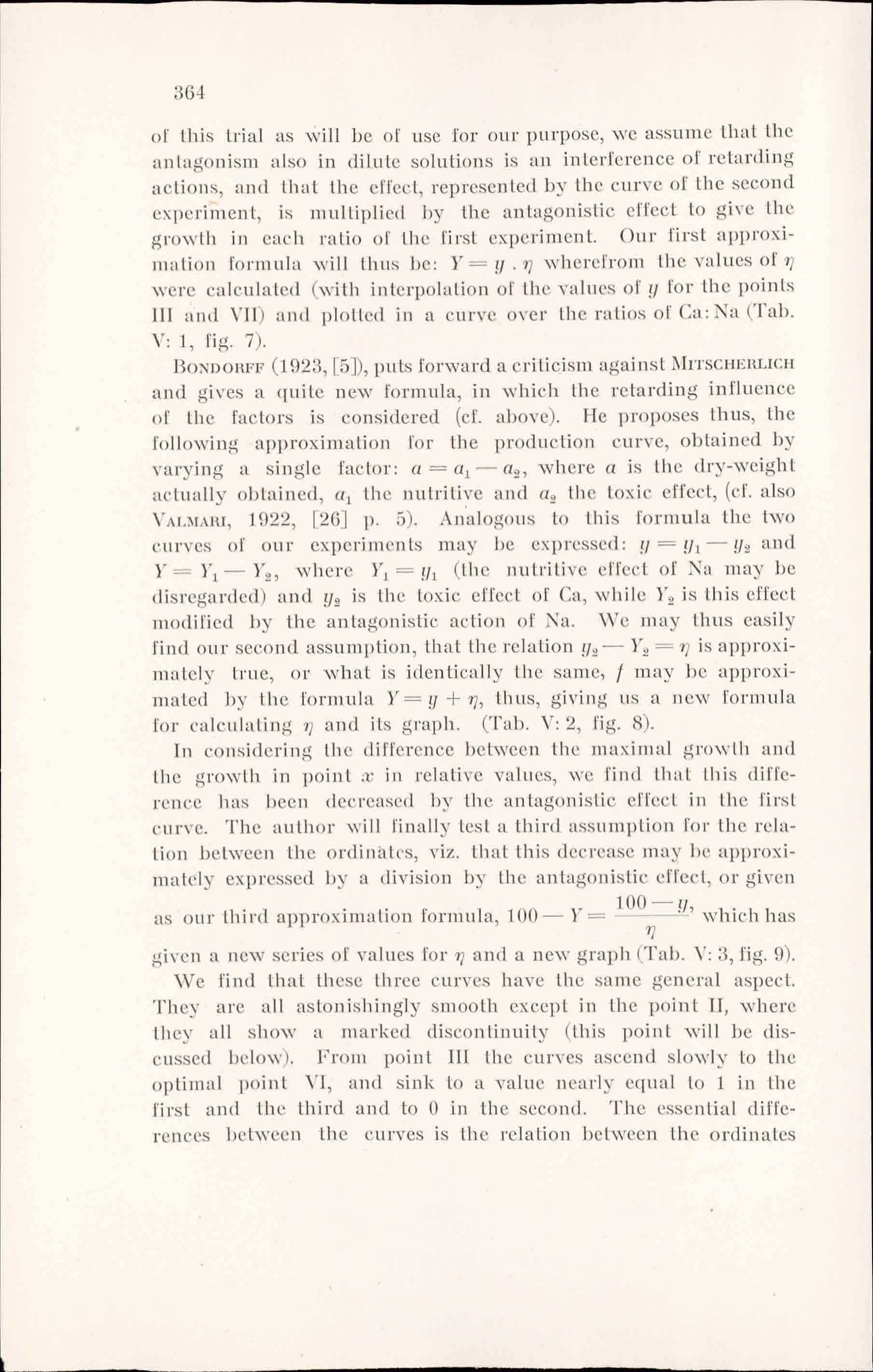
of this trial as will be of use for our purpose, we assume that the
antagonism also in dilute solutions is an interference of retarding
actions, and that the effect, represented by the curve of the second
experiment, is multiplied by the antagonistic effect to give the
growth in each ratio of the first experiment. Our first approxi-
mation formula will thus be: Y=y.n wherefrom the values of 7
were calculated (with interpolation of the values of y for the points
III and VII) and plotted in a curve over the ratios of Ca: Na (Tab.
V: 1, fig. 7).
Boxponrr (1923, [5]), puts forward a criticism against MITSCHERLICH
and gives a quite new formula, in which the retarding influence
of the factors is considered (cf. above) He proposes thus, the
following approximation for the production curve, obtained by
varying a single factor: a — a, — as, where a is the dry-weight
actually obtained, a, the nutritive and a, the toxic effect, (cf. also
VaLMaARI 1922, [26] p. 5). Analogous to this formula the two
curves of our experiments may be expressed: y = jy, — ya and
Y—Y,— Y, where Y,— y, (the nutritive effect of Na may be
disregarded) and ys is the toxic effect of Ca, while Y, is this effect
modified by the antagonistic action of Na. We may thus easily
find our second assumption, that the relation g; — Y, = 7 is approxi-
malely true, or what is identically the same, / may be approxi-
mated by the formula Y — y +7, thus, giving us a new formula
for caleulating » and its graph. (Tab. V: 2, fig. 8).
In considering the difference between the maximal growth and
the growth in point x in relative values, we find that this diffe-
rence has been decreased by the antagonistic effect in the first
curve. The author will finally test a third assumption for the rela-
tion between the ordinates, viz. that this decrease may be approxi-
mately expressed by a division by the antagonistic effect, or given
100 — y,
1
given a new series of values for 7 and a new graph (Tab. V: 3, fig. 9).
as our third approximalion formula, 100 — Y — which has
We find that these three curves have the same general aspect.
They are all astonishingly smooth except in the point II, where
they all show a marked disconlinuity (this point will be dis-
cussed below). From point III the curves ascend slowly to the
optimal point VI, and sink to a value nearly equal to 1 in the
first and the third and to 0 in the second. The essential diffe-
rences between the curves is the relation between the ordinates
<< prev. page << föreg. sida << >> nästa sida >> next page >>