Full resolution (JPEG) - On this page / på denna sida - Sidor ...

<< prev. page << föreg. sida << >> nästa sida >> next page >>
Below is the raw OCR text
from the above scanned image.
Do you see an error? Proofread the page now!
Här nedan syns maskintolkade texten från faksimilbilden ovan.
Ser du något fel? Korrekturläs sidan nu!
This page has never been proofread. / Denna sida har aldrig korrekturlästs.
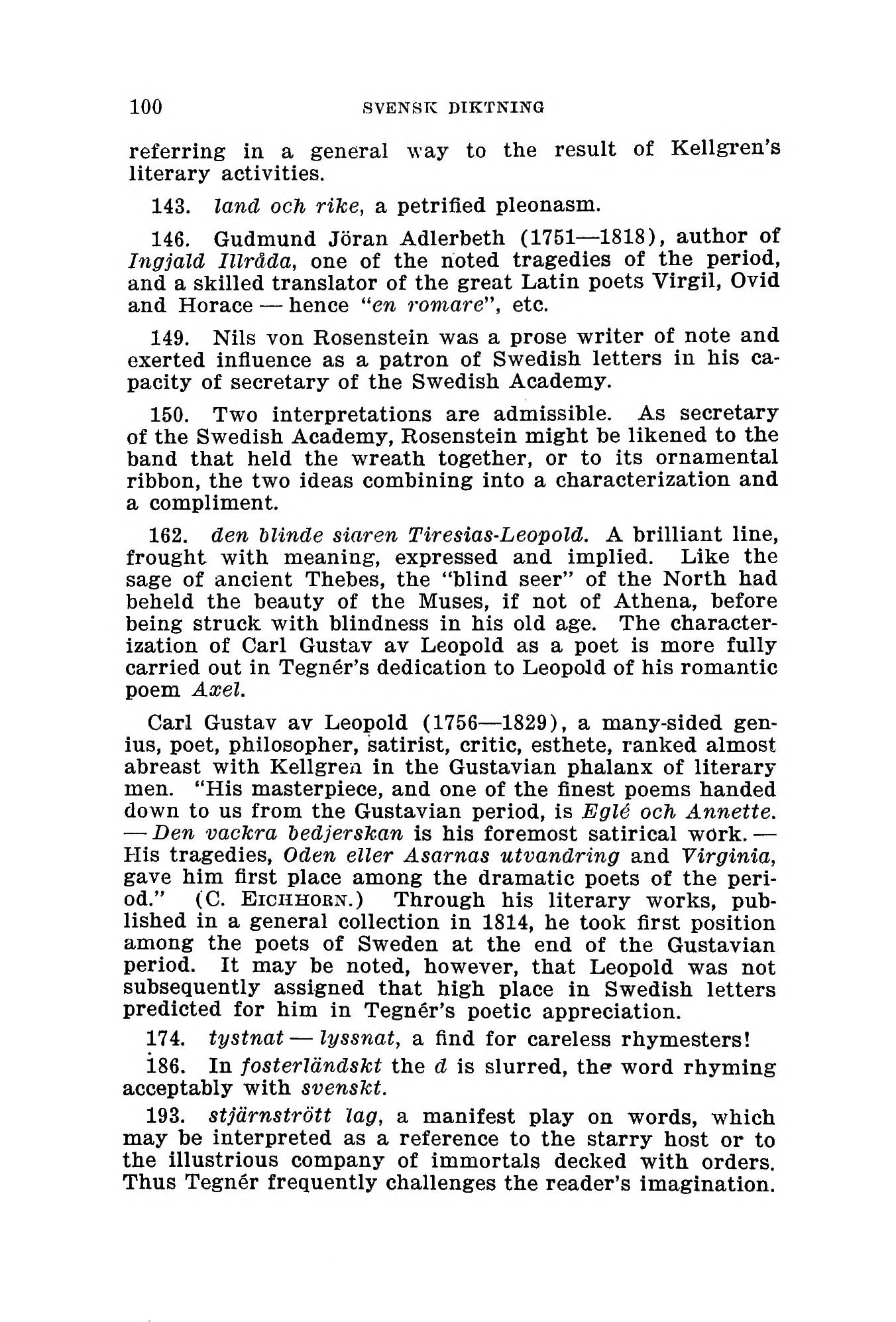
100 SVENSK DIKTNING
referring in a general way to the result of Kellgren’s
literary activities.
143. land och rike, a petrified pleonasm.
146. Gudmund Jöran Adlerbeth (1751—1818), author of
Ingjald Illråda, one of the noted tragedies of the period,
and a skilled translator of the great Latin poets Virgil, Ovid
and Horace — hence "en romare”, etc.
149. Nils von Rosenstein was a prose writer of note and
exerted influence as a patron of Swedish letters in his
capacity of secretary of the Swedish Academy.
150. Two interpretations are admissible. As secretary
of the Swedish Academy, Rosenstein might be likened to the
band that held the wreath together, or to its ornamental
ribbon, the two ideas combining into a characterization and
a compliment.
162. den blinde siaren Tiresias-Leopold. A brilliant line,
frought with meaning, expressed and implied. Like the
sage of ancient Thebes, the "blind seer” of the North had
beheld the beauty of the Muses, if not of Athena, before
being struck with blindness in his old age. The
characterization of Carl Gustav av Leopold as a poet is more fully
carried out in Tegnér’s dedication to Leopold of his romantic
poem Axel.
Carl Gustav av Leopold (1756—1829), a many-sided
genius, poet, phbilosopher, satirist, critic, esthete, ranked almost
abreast with Kellgren in the Gustavian phalanx of literary
men. "His masterpiece, and one of the finest poems handed
down to us from the Gustavian period, is Eglé och Annette.
— Den vackra bedjerskan is his foremost satirical work. —
His tragedies, Oden eller Asarnas utvandring and Virginia,
gave him first place among the dramatic poets of the
period.” AC. EICHHORN.) Through his literary works,
published in a general collection in 1814, he took first position
among the poets of Sweden at the end of the Gustavian
period. It may be noted, however, that Leopold was not
subsequently assigned that high place in Swedish letters
predicted for him in Tegnér’s poetic appreciation.
174. tystnat — lyssnat, a find for careless rhymesters!
186. In fosterländskt the d is slurred, the word rhyming
acceptably with svenskt.
193. stjärnstrött lag, a manifest play on words, which
may be interpreted as a reference to the starry host or to
the illustrious company of immortals decked with orders.
Thus Tegnér frequently challenges the reader’s imagination.
<< prev. page << föreg. sida << >> nästa sida >> next page >>