Full resolution (JPEG) - On this page / på denna sida - Sidor ...

<< prev. page << föreg. sida << >> nästa sida >> next page >>
Below is the raw OCR text
from the above scanned image.
Do you see an error? Proofread the page now!
Här nedan syns maskintolkade texten från faksimilbilden ovan.
Ser du något fel? Korrekturläs sidan nu!
This page has never been proofread. / Denna sida har aldrig korrekturlästs.
A Survey of the English Conjugation. 5
The Anglo-Saxon agrees in the essentials with the Gothic. We
thus find a strong and a weak conjugation, characterized mainly as
above; however, there are a great many changes also, especially in the
vowel-series of the strong conjugation, since the phonological system of
the Anglo-"axon differs widely from that of the Gothic, in as much
as the simplicity of this latter has been totally dispersed in tbat, so
that each Gothic vowel dissolves into two, three and sometimes still
more Anglo-Saxon ones. Entering here upon a development of the
laws in general for these transitions, would perhaps lead us too much
astray, and therefore, referring the reader for further information about
the Anglo-Saxon phonology to GRIMMS German Grammar, vol. I, we
here shall content ourselves with simply examining its particularities,
as they present themselves in the conjugation.
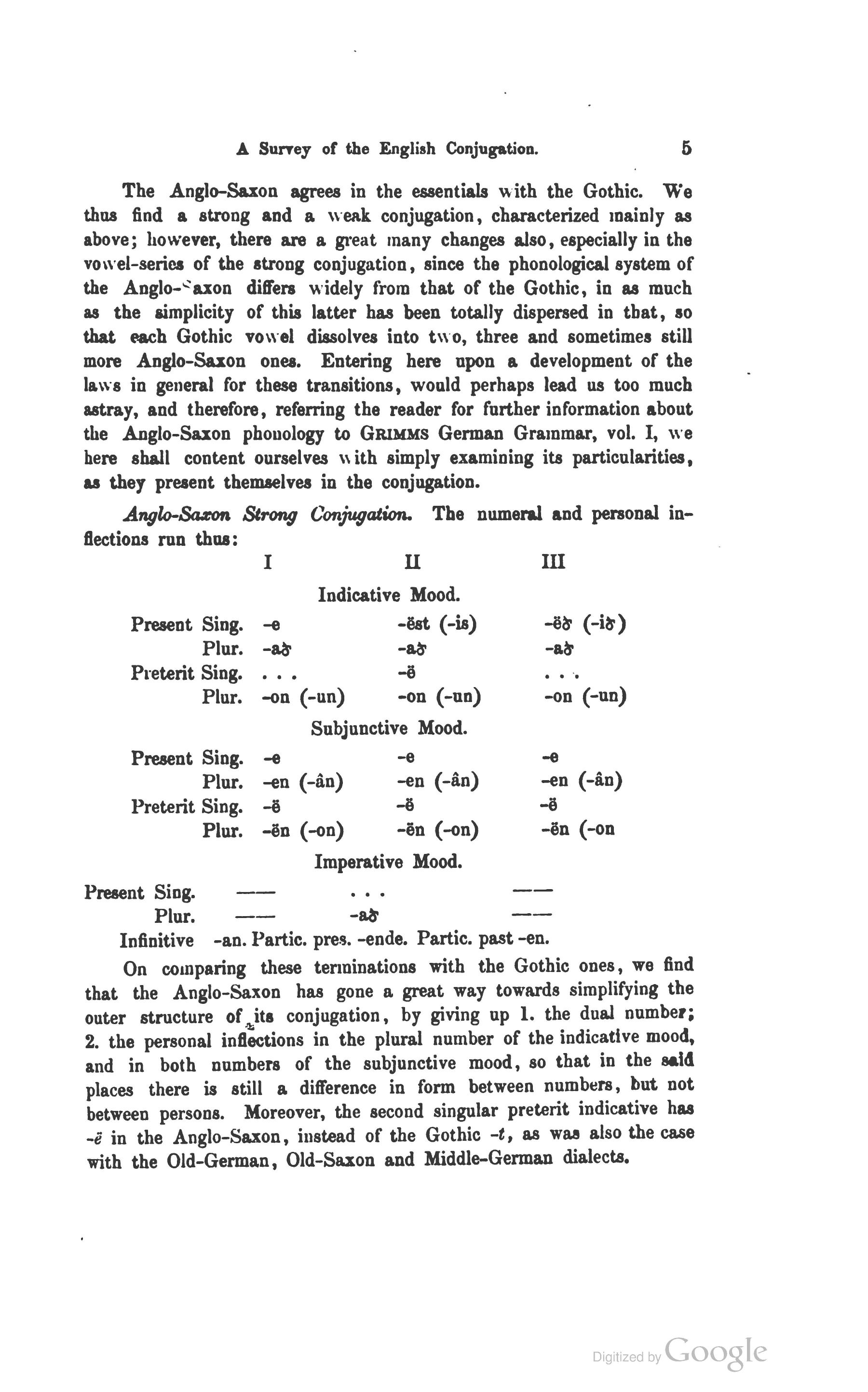
Anglo-Saxon Strong Conjugation. The numeral and personal in-
flections run thus:
I I I
Indicative Mood.
Present Sing. -e -öst (-is) -ö8 (-i8)
Plur. -a& -a8 -ad
Preterit Sing. ... -Ö vä
Plur. -on (-un) -on (-un) -on (-un)
Subjunctive Mood.
Present Sing. -e -e -8
Plur. -en (-ån) -en (-ån) -en (-ån)
Preterit Sing. -ö -ö -ö
Plur. -ön (-on) -ön (-on) -ön (-on
Imperative Mood.
Present Sing. mn sta —
Plur. —— -28 =
Infinitive -an. Partic. pres. -ende. Partic. past -en.
On comparing these terminations with the Gothic ones, we find
that the Anglo-Saxon has gone a great way towards simplifying the
outer structure of ite conjugation, by giving up 1. the dval number;
2. the personal inflections in the plural number of the indicative mood,
and in both numbers of the subjunctive mood, so that in the said
places there is still a difference in form between numbers, but not
between persons. Moreover, the second singular preterit indicative has
-ö in the Anglo-Saxon, instead of the Gothic -t, as was also the case
with the Old-German, Old-Saxon and Middle-German dialects.
<< prev. page << föreg. sida << >> nästa sida >> next page >>