
Full resolution (JPEG) - On this page / på denna sida - Sidor ...
<< prev. page << föreg. sida << >> nästa sida >> next page >>
Below is the raw OCR text
from the above scanned image.
Do you see an error? Proofread the page now!
Här nedan syns maskintolkade texten från faksimilbilden ovan.
Ser du något fel? Korrekturläs sidan nu!
This page has never been proofread. / Denna sida har aldrig korrekturlästs.
6 W. E. Lidforss.
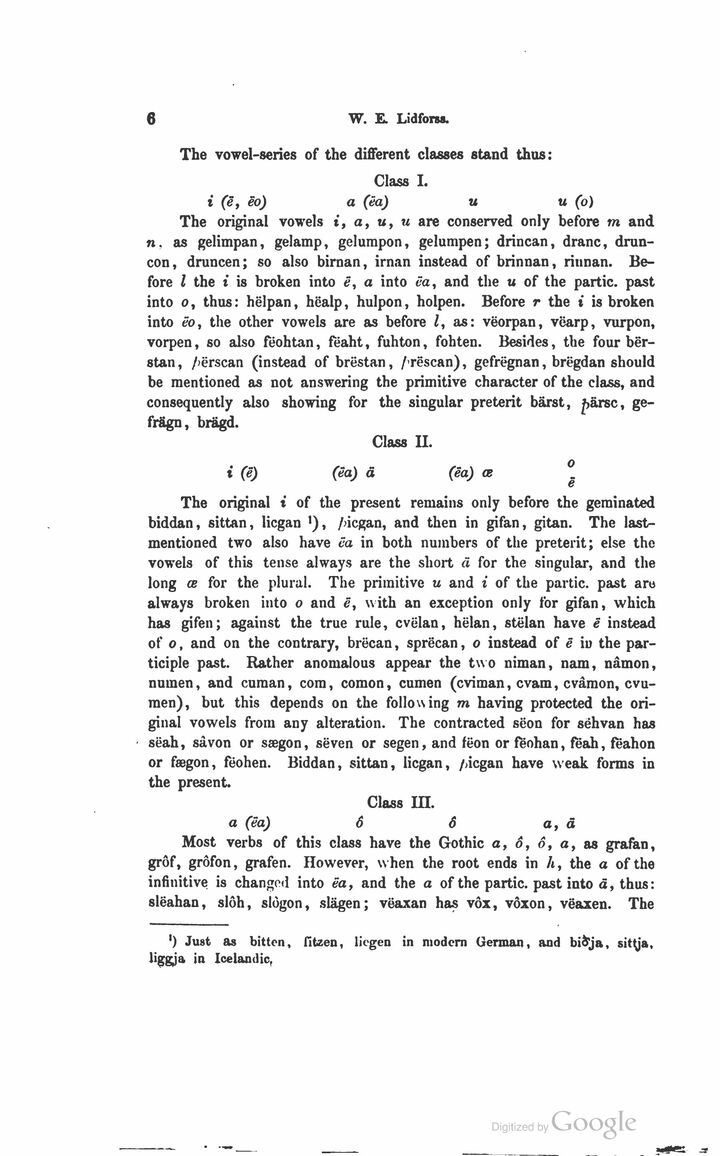
The vowel-series of the different classes stand thus:
Class I.
i (é, éo) a (éa) u u (0)
The original vowels it, a, u, u are conserved only before m and
n, as gelimpan, gelamp, gelumpon, gelumpen; drincan, dranc, drun-
con, druncen; so also birnan, irnan instead of brinnan, rinnan. Be-
fore I the i is broken into éö, a into éa, and the u of the partic. past
into o, thus: hölpan, höalp, hulpon, holpen. Before 7 the i is broken
into éo, the other vowels are as before I, as: vöorpan, vöarp, vurpon,
vorpen, so also föohtan, föaht, fuhton, fohten. Besides, tbe four bör-
stan, Pörscan (instead of bröstan, /’röscan), gefrögnan, brögdan should
be mentioned as not answering the primitive character of the class, and
consequently also showing for the singular preterit bärst, pärsc, ge-
frägn, brägd.
Class II.
i (0 (éa) ä (éa) & j
The original i of the present remains only before the geminated
biddan, sittan, licgan !), picgan, and then in gifan, gitan. The last-
mentioned two also have äa in both numbers of the preterit; else the
vowels of this tense always are the short ä for the singular, and the
long & for the plural. The primitive u and i of the partie. past are
always broken into o and é, with an exception only for gifan, which
has gifen; against the true rule, cvölan, hölan, stölan have é instead
of o, and on the contrary, bröcan, spröcan, o instead of é iv the par-
ticiple past. Rather anomalous appear the two niman, nam, nåmon,
numen, and cuman, com, comon, cumen (cviman, cvam, cvåmon, cvu-
men), but this depends on the following m having protected the ori-
ginal vowels from any alteration. The contracted söon for séhvan has
: söah, såvon or segon, söven or segen, and föon or föohan, föah, föahon
or fegon, féohen. Biddan, sittan, licgan, picgan have weak forms in
the present.
Class III.
a (éa) 6 Ö a, ä
Most verbs of this class have the Gothic a, ö, 6, a, as grafan,
gröf, gröfon, grafen. However, when the root ends in Ah, the a of the
infinitive is changed into éa, and the a of the partic. past into ä, thus:
slöahan, slöh, slögon, slägen; vöaxan has vöx, vöxon, vöaxen. The
’) Just as bitten, fitzen, liegen in modern German, and bidja, sittja,
liggja in Icelandic,
<< prev. page << föreg. sida << >> nästa sida >> next page >>


