
Full resolution (JPEG) - On this page / på denna sida - Sidor ...
<< prev. page << föreg. sida << >> nästa sida >> next page >>
Below is the raw OCR text
from the above scanned image.
Do you see an error? Proofread the page now!
Här nedan syns maskintolkade texten från faksimilbilden ovan.
Ser du något fel? Korrekturläs sidan nu!
This page has never been proofread. / Denna sida har aldrig korrekturlästs.
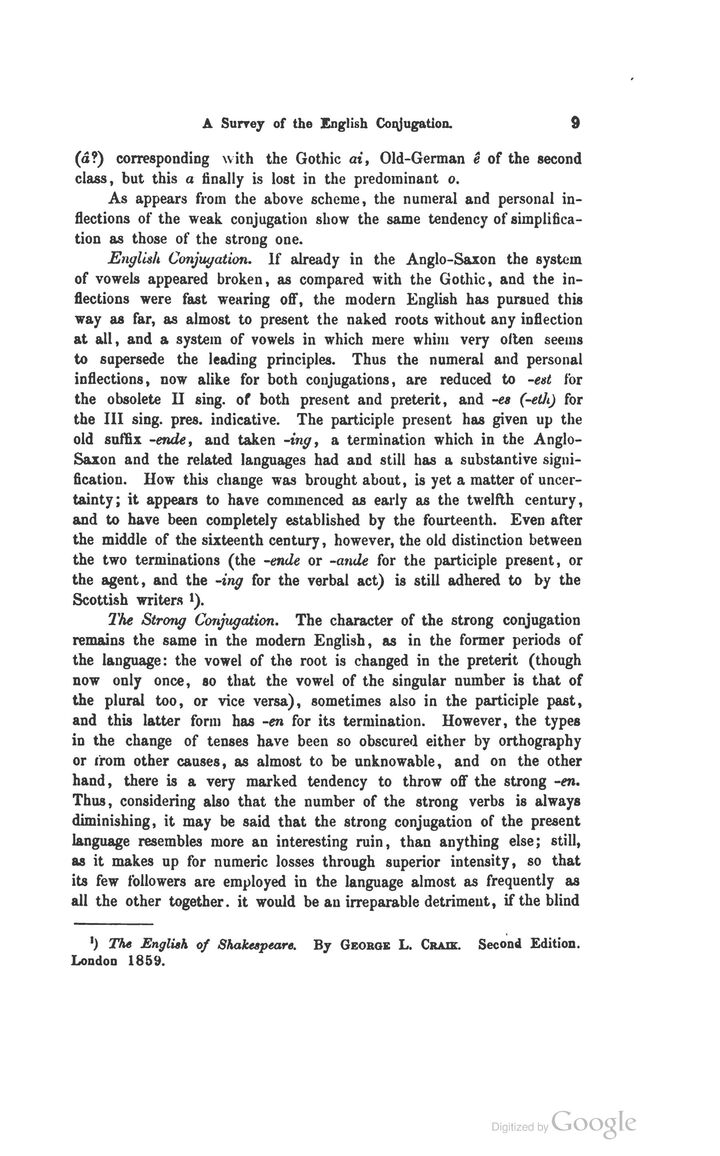
A Survey of the English Conjugation. 9
(4?) corresponding with the Gothic at, Old-German é of the second
class, but this a finally is lost in the predominant o.
Ås appears from the above scheme, the numeral and personal in-
flections of the weak conjugation show the same tendency of simplifica-
tion as those of the strong one.
English Conjugation. 1f already in the Anglo-Saxon the system
of vowels appeared broken, as compared with the Gothic, and the in-
flections were fast wearing off, the modern English has pursued this
way as far, as almost to present the naked roots without any inflection
at all, and a system of vowels in which mere whim very often seems
to sapersede the leading principles. Thus the numeral and personal
inflections, now alike for both conjugations, are reduced to -est for
the obsolete II sing. of both present and preterit, and -es (-eth) for
tbe III sing. pres. indicative. The participle present has given up the
old suffix -ende, and taken -ing, a termination which in the Anglo-
Saxon and the related languages had and still has a substantive signi-
fication. How this change was brought about, is yet a matter of uncer-
tainty; it appears to have commenced as early as the twelfth century,
and to have been completely established by the fourteenth. Even after
the middle of the sixteenth century, however, the old distinction between
the two terminations (the -ende or -ande for the participle present, or
the agent, and the -ing for the verbal act) is still adhered to by the
Scottish writers !).
The Strong Conjugation. The character of the strong conjugation
remains the same in the modern English, as in the former periods of
the language: the vowel of the root is changed in the preterit (though
now only once, 80 that the vowel of the singular number is that of
the plural too, or vice versa), sometimes also in the participle past,
and this latter form has -en for its termination. However, the types
in the change of tenses have been so obscured either by orthography
or from other causes, as almost to be unknowable, and on the other
hand, there is a very marked tendency to throw off the strong -en.
Thus, considering also that the number of the strong verbs is always
diminishing, it may be said that the strong conjugation of the present
language resembles more an interesting ruin, than anything else; still,
as it makes up for numeric losses through superior intensity, so that
its few followers are employed in the language almost as frequently as
all the other together. it would be an irreparable detriment, if the blind
!) The English of Shakespeare. By GEORGE L. CRAIK. Second Edition.
London 1859.
<< prev. page << föreg. sida << >> nästa sida >> next page >>


