
Full resolution (JPEG) - On this page / på denna sida - Sidor ...
<< prev. page << föreg. sida << >> nästa sida >> next page >>
Below is the raw OCR text
from the above scanned image.
Do you see an error? Proofread the page now!
Här nedan syns maskintolkade texten från faksimilbilden ovan.
Ser du något fel? Korrekturläs sidan nu!
This page has never been proofread. / Denna sida har aldrig korrekturlästs.
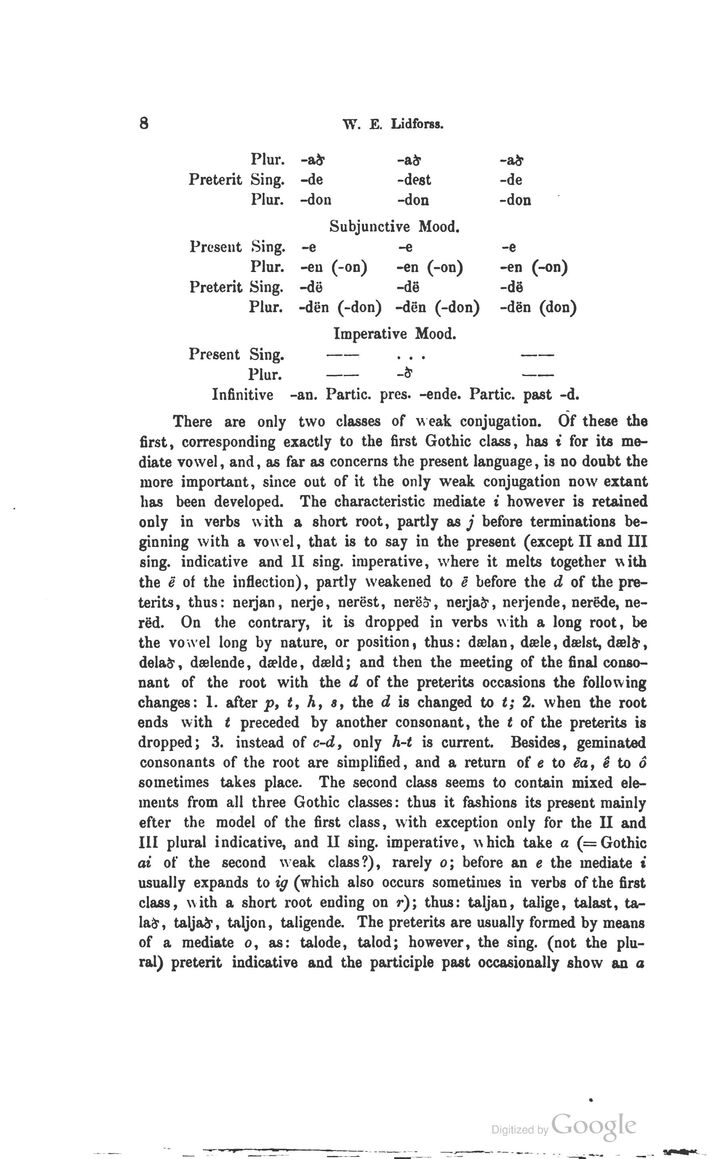
8 W. E. Lidforss.
Plur. -a -ad -ad
Preterit Sing. -de -dest -de
Plur. -don -don -don
Subjunctive Mood.
Present Sing. -e -e -e
Plur. -en (-on) = -en (-on) -en (-on)
Preterit Sing. -dö -dö -dö
Plur. -dön (-don) -dön (-don) -dön (don)
Imperative Mood.
Present Sing. —— åa —
Plur. —— -85 —
Infinitive -an. Partic. pres. -ende. Partic. past -d.
There are only two classes of weak conjugation. Of these the
first, corresponding exactly to the first Gothic class, has t for its me-
diate voswel, and, as far as concerns the present language, is no doubt the
more important, since out of it the only weak conjugation now extant
has been developed. The characteristic mediate i however is retained
only in verbs with a short root, partly as j before terminations be-
ginning with a vowel, that is to say in the present (except II and III
sing. indicative and 1I sing. imperative, where it melts together wvith
the é of the inflection), partly weakened to é before the d of the pre-
terits, thus: nerjan, nerje, neröst, nerö3, nerjad, nerjende, neröde, ne-
röd. On the contrary, it is dropped in verbs with a long root, be
the voivel long by nature, or position, thus: delan, dele, delst, del: ,
dela3, delende, delde, deld; and then the meeting of the final conso-
nant of the root with the d of the preterits occasions the following
changes: 1. after p, t, Ah, 8, the d is changed to t; 2. when the root
ends with t preceded by another consonant, the t of the preterits is
dropped; 3. instead of c-d, only A-t is current. Besides, geminated
consonants of the root are simplified, and a return of e to éa, é to ö
sometimes takes place. The second class seems to contain mixed ele-
ments from all three Gothic classes: thus it fashions its present mainly
efter the model of the first class, with exception only for the II and
ILI plural indicative, and II sing. imperative, which take a (= Gothic
a of the second weak class?), rarely o; before an e the mediate i
usually expands to ig (which also occurs sometimes in verbs of the first
class, with a short root ending on >); thus: taljan, talige, talast, ta-
lad, taljar, taljon, taligende. The preterits are usually formed by means
of a mediate o, as: talode, talod; however, the sing. (not the plu-
ral) preterit indicative and the participle past occasionally show an a
<< prev. page << föreg. sida << >> nästa sida >> next page >>


