
Full resolution (JPEG) - On this page / på denna sida - Sidor ...
<< prev. page << föreg. sida << >> nästa sida >> next page >>
Below is the raw OCR text
from the above scanned image.
Do you see an error? Proofread the page now!
Här nedan syns maskintolkade texten från faksimilbilden ovan.
Ser du något fel? Korrekturläs sidan nu!
This page has never been proofread. / Denna sida har aldrig korrekturlästs.
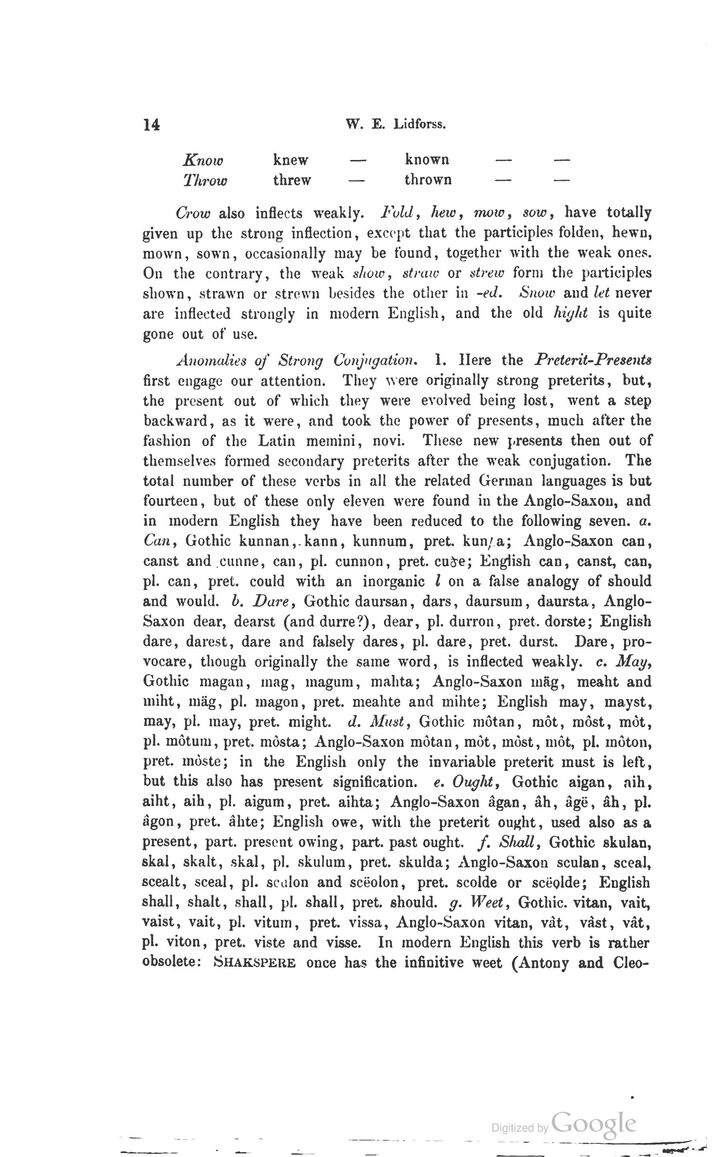
14 W. E. Lidforss.
Know knew — known — =
Throw threw — thrown — —
Crow also inflects weakly. Hold, hew, mow, sow, have totally
given up the strong inflection, except that the participles folden, hewn,
mown, sown, occasionally may be found, together with the weak ones.
On the contrary, the weak show, straw or strew form the participles
shown, strawn or strewn besides the other in -ed. Snow and let never
are inflected strongly in modern English, and the old hight is quite
gone out of use.
Anomalies of Strong Conjugation. 1. Here the Preterit-Presents
first engage our attention. They were originally strong preterits, but,
the present out of which they were evolved being lost, went a step
backward, as it were, and took the power of presents, much after the
fashion of the Latin memini, novi. These new presents then out of
themselves formed secondary preterits after the weak conjugation. The
total number of these verbs in all the related German languages is but
fourteen, but of these only eleven were found in the Anglo-Saxon, and
in modern English they have been reduced to the following seven. a.
Can, Gothic kunnan, kann, kunnum, pret. kun/a; Anglo-Saxon can,
canst and cunne, can, pl. cunnon, pret. cu3e; English can, canst, can,
pl. can, pret. could with an inorganic I! on a false analogy of should
and would. b. Dare, Gothic daursan, dars, daursum, daursta, Anglo-
Saxon dear, dearst (and durre?), dear, pl. durron, pret. dorste; English
dare, darest, dare and falsely dares, pl. dare, pret. durst. Dare, pro-
vocare, though originally the same word, is inflected weakly. c. May,
Gothic magan, mag, magum, mahta; Anglo-Saxon mäg, meaht and
miht, mäg, pl. magon, pret. meahte and mihte; English may, mayst,
may, pl. may, pret. might. d. Must, Gothic mötan, möt, möst, möt,
pl. mötum, pret. mösta; Anglo-Saxon mötan, möt, måst, möt, pl. möton,
pret. möste; in the English only the invariable preterit must is left,
but this also has present signification. e. Ought, Gothic aigan, aih,
aiht, aih, pl. aigum, pret. aihta; Anglo-Saxon ågan, åh, ågö, åh, pl.
ågon, pret. åhte; English owe, with the preterit ought, used also as a
present, part. present owing, part. past ought. /f. Shall, Gothic skulan,
skal, skalt, skal, pl. skulum, pret. skulda; Anglo-Saxon sculan, sceal,
scealt, sceal, pl. sculon and scöolon, pret. scolde or scöolde; English
shall, shalt, shall, pl. shall, pret. should. g. Weet, Gothic. vitan, vait,
vaist, vait, pl. vitum, pret. vissa, Anglo-Saxon vitan, våt, våst, våt,
pl. viton, pret. viste and visse. In modern English this verb is rather
obsolete: SHAKSPERE once has the infinitive weet (Antony and Cleo-
<< prev. page << föreg. sida << >> nästa sida >> next page >>


