
Full resolution (JPEG) - On this page / på denna sida - Sidor ...
<< prev. page << föreg. sida << >> nästa sida >> next page >>
Below is the raw OCR text
from the above scanned image.
Do you see an error? Proofread the page now!
Här nedan syns maskintolkade texten från faksimilbilden ovan.
Ser du något fel? Korrekturläs sidan nu!
This page has never been proofread. / Denna sida har aldrig korrekturlästs.
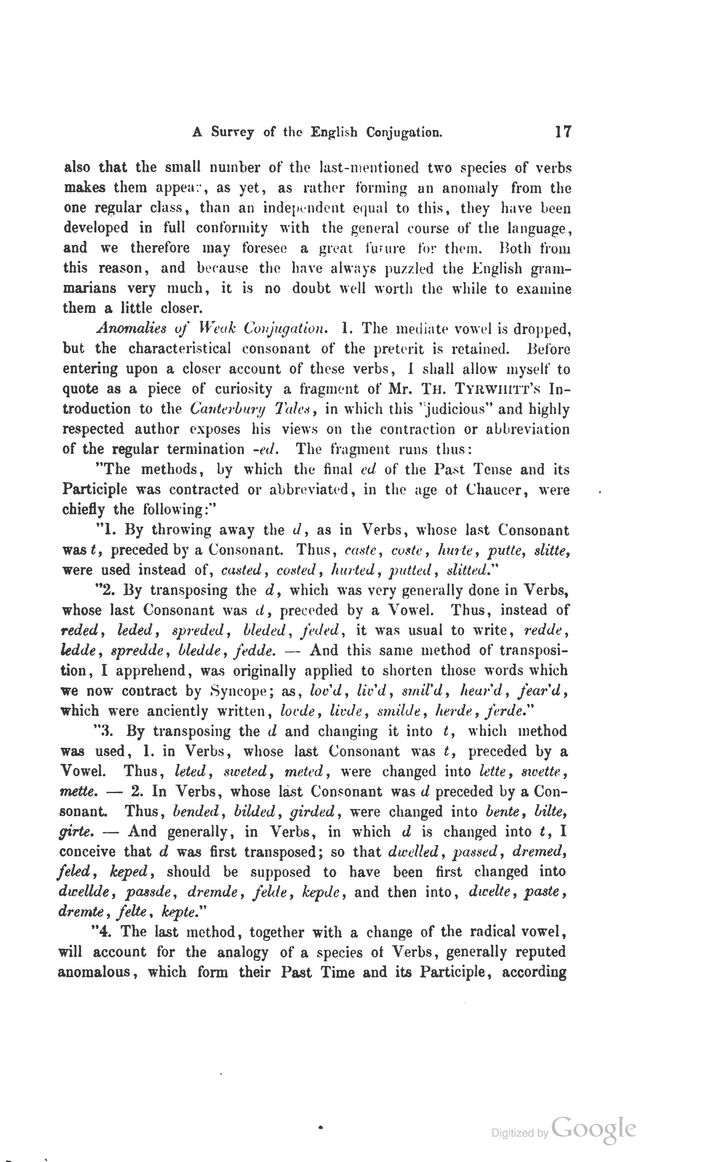
A Survey of the English Conjugation. 17
also that the small number of the last-mentioned two species of verbs
makes them appea:, as yet, as rather forming an anomaly from the
one regular class, than an independent equal to this, they have been
developed in full conformity with the general course of the language,
and we therefore may foresec a great furure for them. Both from
this reason, and because the have alway& puzzled tbe English gram-
marians very much, it is no doubt well worth the while to examine
them a little closer.
Anomalies of Weak Conjugation. 1. The mediate vowel is dropped,
but the characteristical consonant of the preterit is retained. Before
entering upon a closer account of these verbs, I shall allow myself to
quote as a piece of curiosity a fragment of Mr. TH. TYRWHITT’S In-
troduction to the Canterbury Tales, in which this ”judicious” and highly
respected author cexposes his views on the contraction or abbreviation
of the regular termination -ed. The fragment runs thus:
”The methods, by which the final ed of the Past Tense and its
Participle was contracted or abbreviated, in the age ot Chaucer, were
chiefly the following:”
”1. By throwing away the d, as in Verbs, whose last Consonpant
was t, preceded by a Consonant. Thus, caste, coste, hurte, putte, slitte,
were used instead of, casted, costed, hurted, putted, slitted.”
"2. By transposing the d, which was very generally done in Verbs,
whose last Consonant was d, preceded by a Vowel. Thus, instead of
reded, leded, spreded, bleded, feded, it was usual to write, redde,
ledde, spredde, bledde, fedde. — And this same method of transposi-
tion, I apprehend, was originally applied to shorten those words which
we now contract by Syncope; as, lov’d, livd, smild, hear’d, fear’d,
which were anciently written, lovde, livde, smilde, herde, ferde.”
”3. By transposing the d and changing it into t£, which method
was used, 1. in Verbs, whose last Consonant was t, preceded by a
Vowel. Thus, leted, sweted, meted, were changed into lette, swette,
mette. — 2. In Verbs, whose last Consonant was d preceded by a Con-
sonant. Thus, bended, bilded, girded, were changed into bente, bilte,
girte. — And generally, in Verbs, in which d is changed into t, I
conceive that d was first transposed; so that dwelled, passed, dremed,
feled, keped, should be supposed to have been first changed into
dwellde, passde, dremde, felde, kepde, and then into, dwelte, paste,
dremte , felte, kepte.”
"4. The last method, together with a change of the radical vowel,
will account for the analogy of a species ot Verbs, generally reputed
anomalous, which form their Past Time and its Participle, according
<< prev. page << föreg. sida << >> nästa sida >> next page >>


