
Full resolution (JPEG) - On this page / på denna sida - Sidor ...
<< prev. page << föreg. sida << >> nästa sida >> next page >>
Below is the raw OCR text
from the above scanned image.
Do you see an error? Proofread the page now!
Här nedan syns maskintolkade texten från faksimilbilden ovan.
Ser du något fel? Korrekturläs sidan nu!
This page has never been proofread. / Denna sida har aldrig korrekturlästs.
18 W. E. Lidforss.
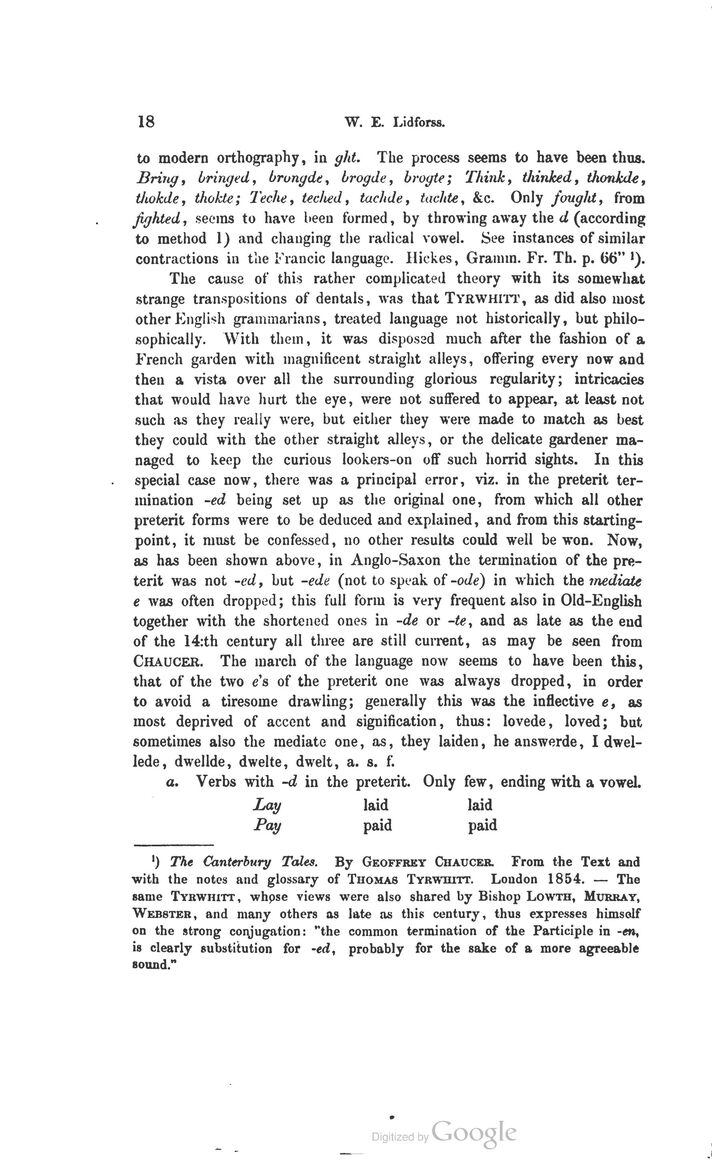
to modern orthography, in ght. The process seems to have been thus.
Bring, bringed, brongde, brogde, brogte; Think, thinked, thonkde,
thokde , thokte; Teche, teched, tachde, tachte, &c. Only fouglt, from
Jighted, seems to have been formed, by throwing away the d (according
to method 1) and changing the radical vowel. See instances of similar
contractions in the Irancic language. Hickes, Gramm. Fr. Th. p. 66” !).
The cause of this rather complicated theory with its somewhat
strange transpositions of dentals, was that TYRWHITT, as did also most
other English grammarians, treated language not historically, but philo-
sophically. With them, it was disposed much after the fashion of a
French garden with magnificent straight alleys, offering every now and
then a vista over all the surrounding glorious regularity; intricacies
that would have hurt the eye, were not suffered to appear, at least not
such as they really were, but either they were made to match as best
they could with the otber straight alleys, or the delicate gardener ma-
naged to keep the curious lookers-on off such horrid sights. In this
special case now, there was a principal error, viz. in the preterit ter-
mination -ed being set up as the original one, from which all other
preterit forms were to be deduced and explained, and from this starting-
point, it must be confessed, no other results could well be won. Now,
as has been shown above, in Anglo-Saxon the termination of the pre-
terit was not -ed, but -ede (not to speak of -ode) in which the mediate
e was often dropped; this full form is very frequent also in Old-English
together with the shortened ones in -de or -te, and as late as the end
of the 14:th century all three are still current, as may be seen from
CHAUCER. The march of the language now seems to have been this,
that of the two e’s of the preterit one was always dropped, in order
to avoid a tiresome drawling; generally this was the inflective e, as
most deprived of accent and signification, thus: lovede, loved; but
sometimes also the mediate one, as, they laiden, he answerde, I dwel-
lede, dwellde, dwelte, dwelt, a. s. f.
a. Verbs with -d in the preterit. Only few, ending with a vowel.
Lay laid laid
Pay paid paid
) The Canterbury Tales. By GEOFFREY CHAUCER. From the Text and
with the notes and glossary of THOMAS TYRWIUTT. London 1854. — The
same TYRWHITT, whose views were also shared by Bishop LoOwTtH, MURRAY,
WEBSTER, and many others as late as this century, thus expresses himsolf
on the strong conjugation: ”the common termination of the Participle in -en,
is clearly substitution for -ed, probably for the sake of a more agreeable
sound.”
<< prev. page << föreg. sida << >> nästa sida >> next page >>


