Full resolution (JPEG) - On this page / på denna sida - Sidor ...

<< prev. page << föreg. sida << >> nästa sida >> next page >>
Below is the raw OCR text
from the above scanned image.
Do you see an error? Proofread the page now!
Här nedan syns maskintolkade texten från faksimilbilden ovan.
Ser du något fel? Korrekturläs sidan nu!
This page has never been proofread. / Denna sida har aldrig korrekturlästs.
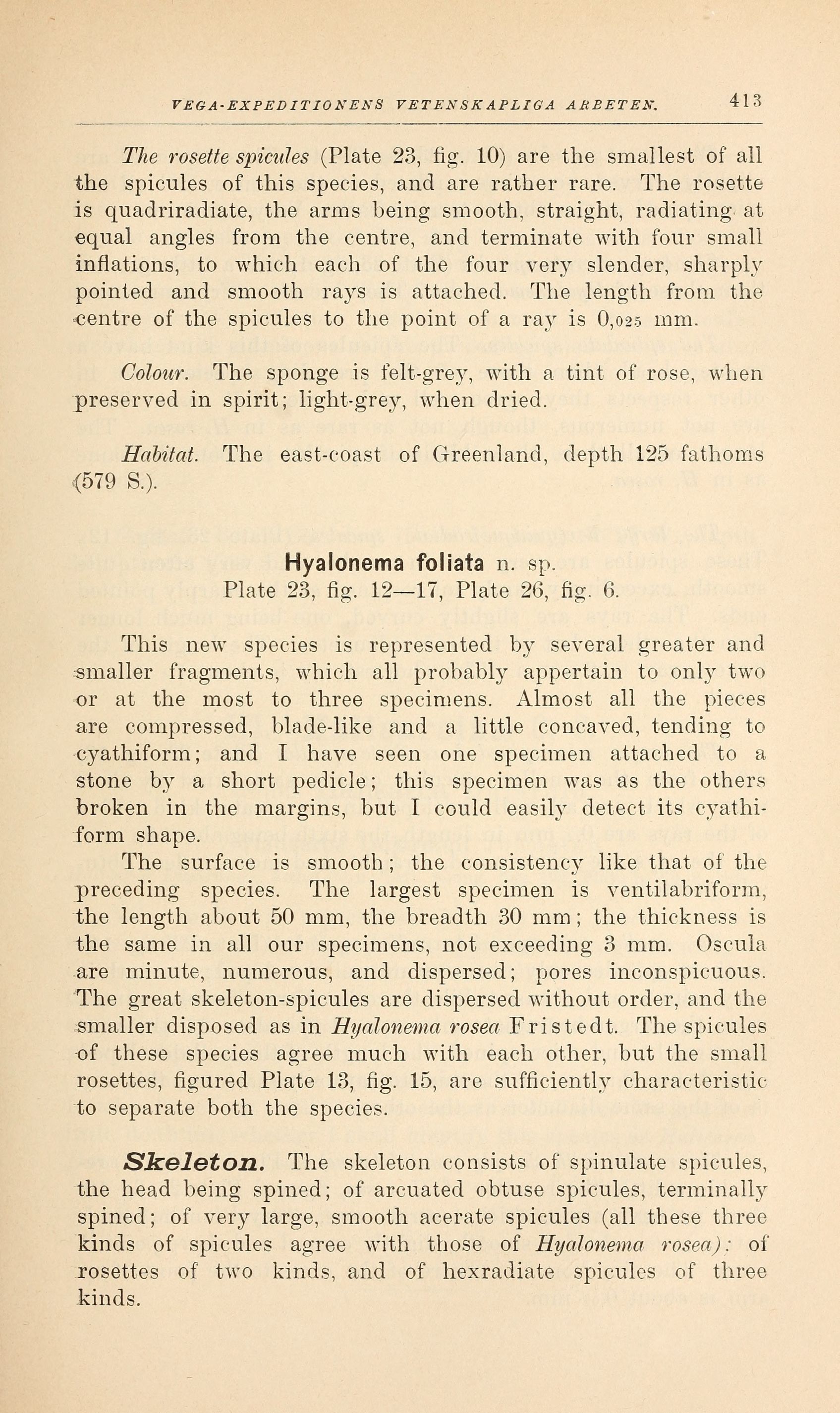
The rosette spicules (Plate 23, fig. 10) are the smallest of all
the spicules of this species, and are rather rare. The rosette
is quadriradiate, the arms being smooth, straight, radiating at
equal angles from the centre, and terminate with four small
inflations, to which each of the four very slender, sharply
pointed and smooth rays is attached. The length from the
•centre of the spicules to the point of a ray is 0,025 mm.
Colour. The sponge is felt-grey, with a tint of rose, when
preserved in spirit; light-grey, when dried.
Habitat. The east-coast of Greenland, depth 125 fathoms
<579 S.).
Hyalonema foliata n. sp.
Plate 23, fig. 12—17, Plate 26, fig. 6.
This new species is represented by several greater and
smaller fragments, which ali probably appertain to only two
or at the most to three specimens. Almost all the pieces
are compressed, blade-like and a little conc-aved, tending to
cyathiform; and I have seen one specimen attached to a
stone by a short pedicle; this specimen was as the others
broken in the margins, but I could easily detect its
cyathiform shape.
The surface is smooth; the consistency like that of the
preceding species. The largest specimen is ventilabriform,
the length about 50 mm, the breadth 30 mm; the thickness is
the same in ali our specimens, not exceeding 3 mm. Oscula
are minute, numerous, and clispersed; pores inconspicuous.
The great skeleton-spicules are clispersed without order, and the
smaller disposed as in Hyalonema rosea Fristedt. The spicules
-of these species agree much with each other, but the small
rosettes, figured Plate 13, fig. 15, are suffieientlv characteristic
to separate both the species.
iSkeleton. The skeleton consists of’ spinulate spicules,
the head being spined; of arcuated obtuse spicules, terminally
spined; of very large, smooth acerate spicules (all these three
kinds of spicules agree with those of Hyalonema rosea): of
rosettes of’ two kinds, and of hexradiate spicules of three
kinds.
<< prev. page << föreg. sida << >> nästa sida >> next page >>