Full resolution (JPEG) - On this page / på denna sida - Sidor ...

<< prev. page << föreg. sida << >> nästa sida >> next page >>
Below is the raw OCR text
from the above scanned image.
Do you see an error? Proofread the page now!
Här nedan syns maskintolkade texten från faksimilbilden ovan.
Ser du något fel? Korrekturläs sidan nu!
This page has never been proofread. / Denna sida har aldrig korrekturlästs.
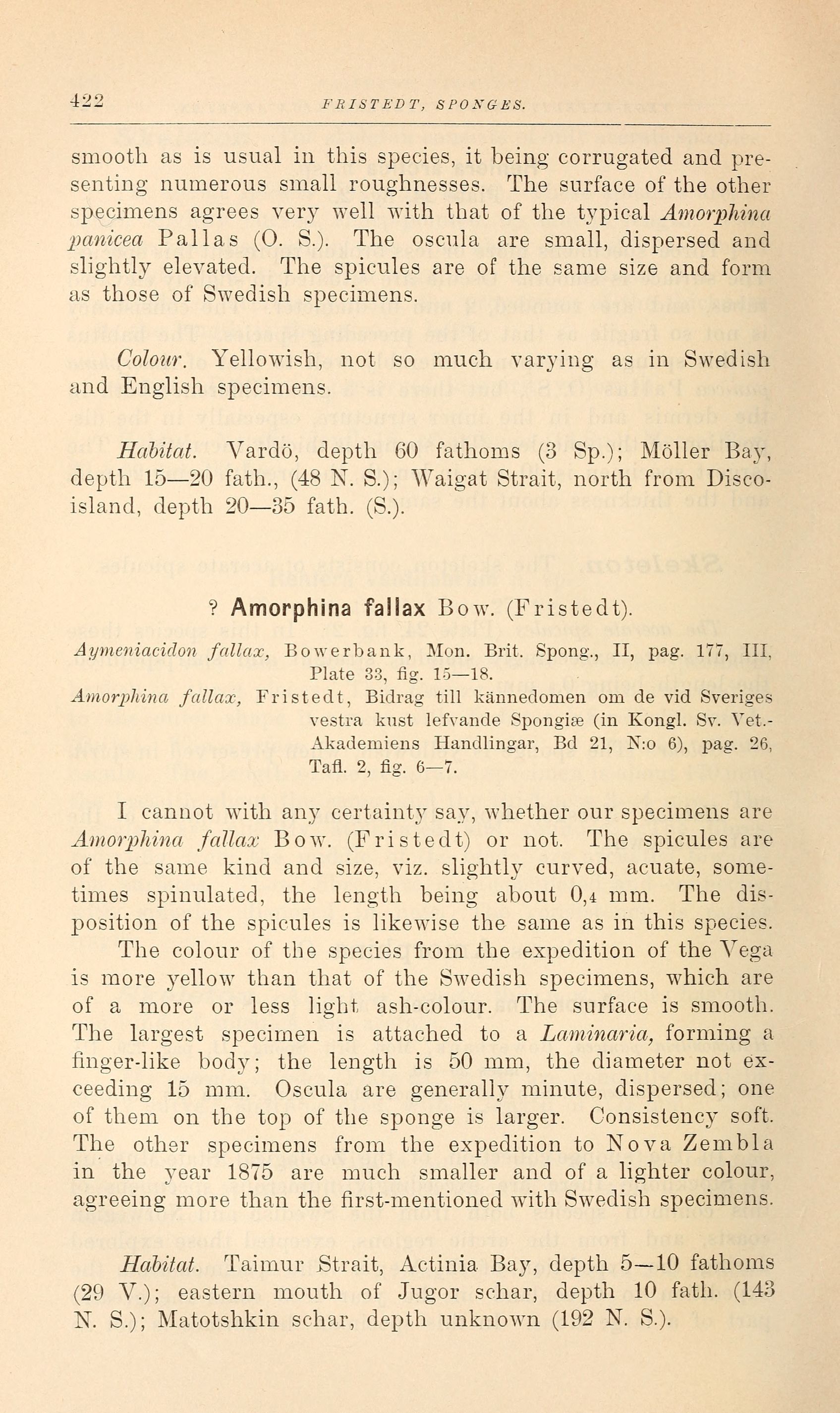
smooth as is usual in this species, it being corrugated and
pre-senting numerous small roughnesses. The surface of the other
specimens agrees very well with that of the typical Amorphina
panicea Pallas (O. S.). The oscula are small, dispersed and
slightly elevated. The spicules are of the same size and form
as those of Swedish specimens.
Colour. Yellowish, not so much varying as in Swedish
and English specimens.
Habitat. Vardö, depth 60 fathoms (3 Sp.); Möller Bay,
depth 15—20 fath., (48 N. S.); Waigat Strait, north from
Disco-island, depth 20—35 fath. (S.).
? Amorphina fallax Bow. (Fristedt).
Aymeniaciclon fallax, Bowerbank, Mon. Brit. Spong., II, pag. 177, III,
Plate 3-3, fig. 15—18.
Amorphina fallax, Fristedt, Bidrag till kännedomen om de vid Sveriges
vestra knst lefvande Spongiae (in Kongi. Sv.
Vet.-Akademiens Handlingar, Bd 21, ls:o 6), pag. 26,
Tafl. 2, fig. 6—7.
I c-annot with any certainty say, whether our specimens are
Amorphina fallax Bo av. (Fristedt) or not. The spicules are
of the same kind and size, viz. slightly curved, aeuate,
some-times spinulated, the length being about 0,4 mm. The
disposition of the spicules is likewise the same as in this species.
The colour of the species from the expedition of the Vega
is more yellow than that of the Swedish specimens, which are
of a more or less light ash-colour. The surface is smooth.
The largest specimen is attac-hed to a Laminaria, forming a
finger-like body; the length is 50 niin, the diameter not
ex-ceeding 15 mm. Oscula are generallv minute, dispersed; one
of them on the top of the sponge is larger. Consistency soft.
The other specimens from the expedition to Nova Zembla
in the year 1875 are much smaller and of a lighter colour,
agreeing more than the first-mentioned with Swedish specimens.
Habitat. Taimur Strait, Actinia Bay, depth 5—10 fathoms
(29 V.); eastern mouth of Jugor schar, depth 10 fath. (143
N. S.); Matotshkin schar, depth unknown (192 N. S.).
<< prev. page << föreg. sida << >> nästa sida >> next page >>