Full resolution (JPEG) - On this page / på denna sida - Sidor ...

<< prev. page << föreg. sida << >> nästa sida >> next page >>
Below is the raw OCR text
from the above scanned image.
Do you see an error? Proofread the page now!
Här nedan syns maskintolkade texten från faksimilbilden ovan.
Ser du något fel? Korrekturläs sidan nu!
This page has never been proofread. / Denna sida har aldrig korrekturlästs.
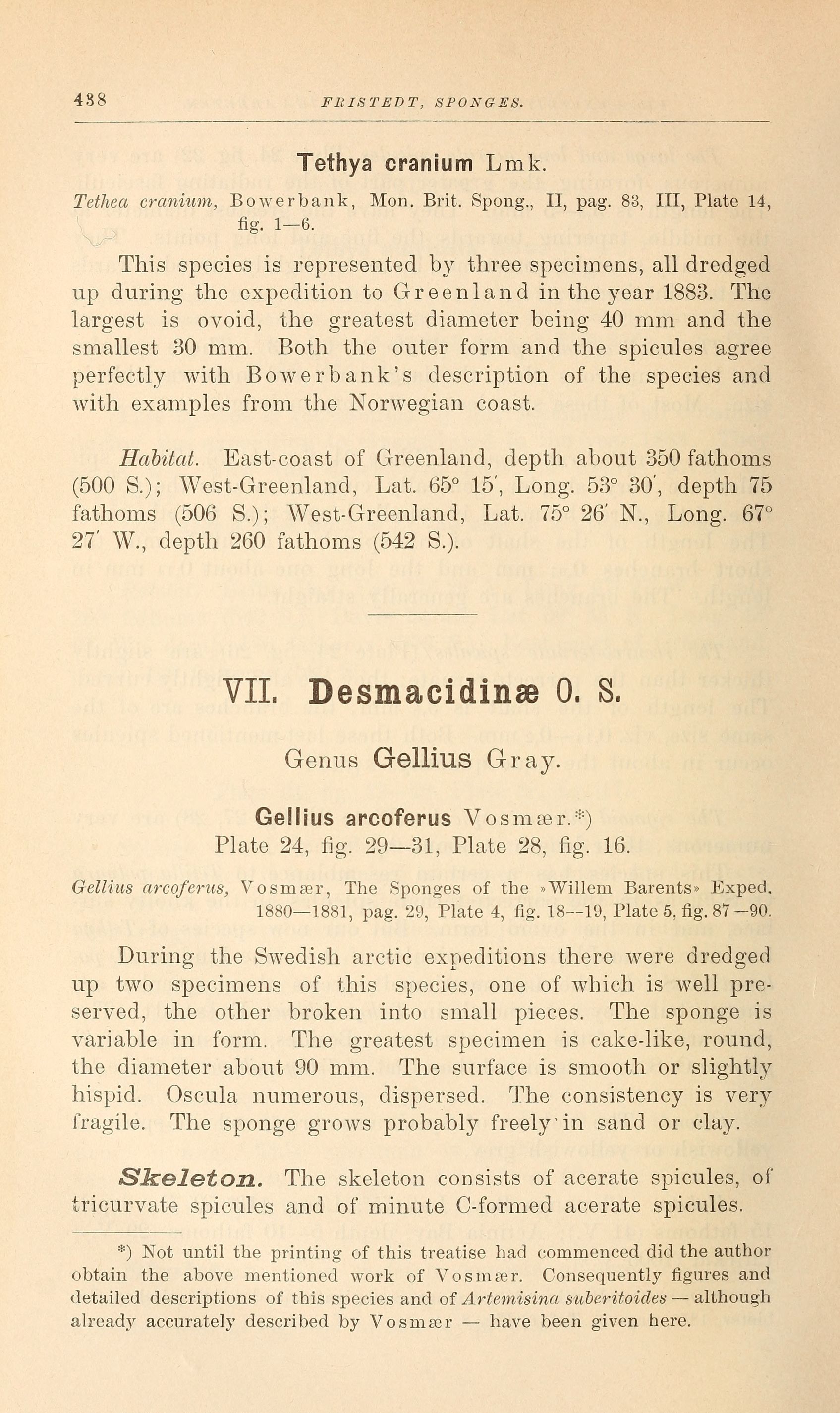
Tethya cranium Lmk.
Tethea cranium, Bowerbank, Mon. Brit. Spong., II, pag. 83, III, Plate 14,
fig. 1—6.
This species is represented by three specimens, ali dredged
up during the expedition to Greenland in the year 1883. The
largest is ovoid, the greatest diameter being 40 mm and the
smallest 30 mm. Both the outer form and the spicules agree
perfectly with Bowerbank’s description of the species and
with examples from the Norwegian coast.
Habitat. East-coast of Greenland, depth about 350 fathoms
(500 S.); West-Greenland, Lat. 65° 15’, Long. 53° 30’, depth 75
fathoms (506 S.); West-Greenland, Lat. 75° 26’ N., Long. 67°
27’ W., depth 260 fathoms (542 S.).
VII. Desmacidinse 0. S.
Genus Gellius Gray.
Gellius arcoferus Vosmser.*)
Plate 24, fig. 29—31, Plate 28, fig. 16.
Gellius arcoferus, Vosmser, The Sponges of the »Willem Barents» Exped.
1880—1881, pag. 29, Plate 4, fig. 18—19, Plate 5, fig. 87-90.
During the Swedish arctic expeditions there were dredged
up two specimens of this species, one of which is well
preserved, the other broken into small pieces. The sponge is
variable in form. The greatest specimen is cake-like, round,
the diameter about 90 mm. The surface is smooth or slightly
hispid. Oscula numerous, dispersed. The consistency is very
fragile. The sponge grows probably freelyin sand or clay.
Skeleton. The skeleton consists of acerate spicules, of
iricurvate spicules and of minute C-formed acerate spicules.
*) Not until the printing of this treatise had commenced did the author
obtain the above mentioned work of V o s m äelr. Consequently figures and
detailed descriptions of this species and of Artemisina suberitoides — although
already accurately described by Vosmser — have been given here.
<< prev. page << föreg. sida << >> nästa sida >> next page >>