Full resolution (JPEG) - On this page / på denna sida - Sidor ...

<< prev. page << föreg. sida << >> nästa sida >> next page >>
Below is the raw OCR text
from the above scanned image.
Do you see an error? Proofread the page now!
Här nedan syns maskintolkade texten från faksimilbilden ovan.
Ser du något fel? Korrekturläs sidan nu!
This page has never been proofread. / Denna sida har aldrig korrekturlästs.
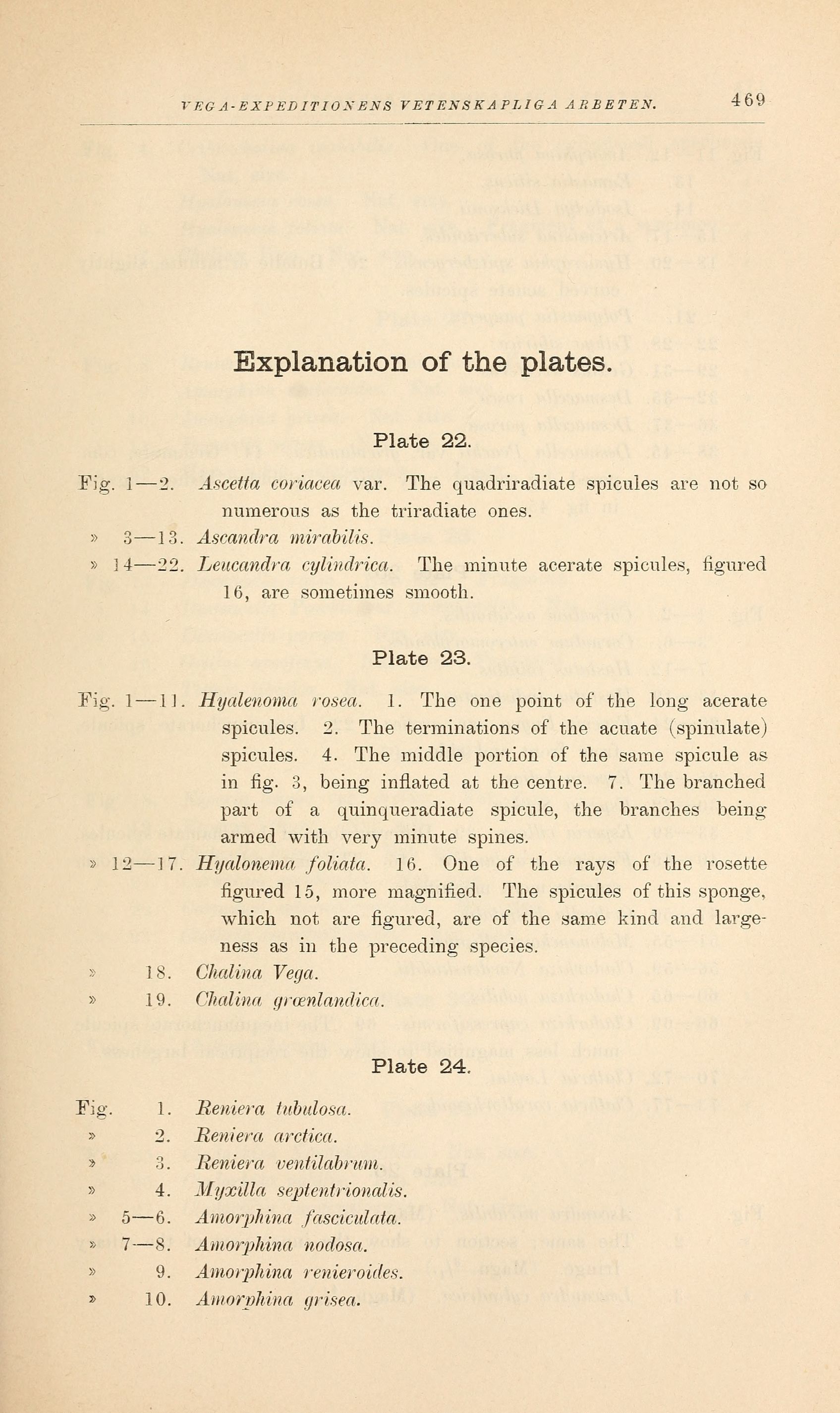
Explanation of the plates.
Plate 22.
Fig. 1—2. Aseetta coriacea var. The quadriradiate spicules are not so
numerous as the triradiate ones.
» 3—13. Ascandra mirabilis.
» 3 4—22. Leucandra cylindrica. The minute acerate spicules, figured
16, are sometimes smooth.
Plate 23.
Fig. 1 — 1J. Hyalenoma rosea. 1. The one point of the long acerate
spicules. 2. The terminations of the acuate (spinulate)
spicules. 4. The middle portion of the same spicule as
in fig. 3, being inflated at the centre. 7. The branched
part of a quinqueradiate spicule, the branches being
armed with very minute spines.
» 12—17. Hyalonema foliata. 16. One of the rays of the rosette
figured 15, more magnified. The spicules of this sponge,
which not are figured, are of the same kind and
large-ness as in the preceding species.
» 18. Cludina Vecjci.
» 19. Cludina grcenlandica.
Plate 24.
Fig. 1. Reniera tiibulosa.
» 2. Reniera arctica.
o O. Reniera ventilabrum.
» 4. Myxilla septentrionalis.
» 5—6. Amorphina fasciculata.
» 7—8. Amorpliina nodosa.
» 9. Amorphina renieroides.
2> 10. Amorphina grisea,
<< prev. page << föreg. sida << >> nästa sida >> next page >>