
Full resolution (TIFF) - On this page / på denna sida - Some remarks upon the geographical distribution of vegetation in the colder Southern Hemisphere. By Carl Skottsberg. Botanist of the Swedish Antarctic Expedition 1901—1903. With 2 maps, tabl. 8 and 9. - General survey of the austral of or palæooceanic (Engler) realm. - II. The subantarctic dominion. - 1. District of subantarctic South America. - A. South Chilian—Fuegian Province.
<< prev. page << föreg. sida << >> nästa sida >> next page >>
Below is the raw OCR text
from the above scanned image.
Do you see an error? Proofread the page now!
Här nedan syns maskintolkade texten från faksimilbilden ovan.
Ser du något fel? Korrekturläs sidan nu!
This page has never been proofread. / Denna sida har aldrig korrekturlästs.
CARL SKOTTSBERG.
the same appearance summer and winter, because the dominating
trees - Nothofagus betuloides, Drimys Winteri and Maytenus
ma-gellanica - and bushes - Berberis ilicifolia, Desfontainea spinosa,
Philesia buxifolia - are all evergreen. The ground in this dense,
dark and moist forest is covered by fallen trunks and branches,
and over the whole ferns and liverworts wrap their soft,
water-drenched carpet. The
higher plants are few
in number; especially
remarkable is
Lebetan-thus myrsinites (Lam.)
Endl., climbing in the
mosscarpet high up in
the trees.
As is well known,
the deciduous
Nothofagus antarctica grows
higher up, above the
sealevel, forming shrubs
where the other species
does not grow (16,
p. 489). Dusen cannot
find any explanation
for this remarkable fact,
chiefly because Hooker
(28) points out that
N. antarctica at Cape
Horn also descends to
the shore. But, in my
opinion, this must be
an exception and no
doubt demands further
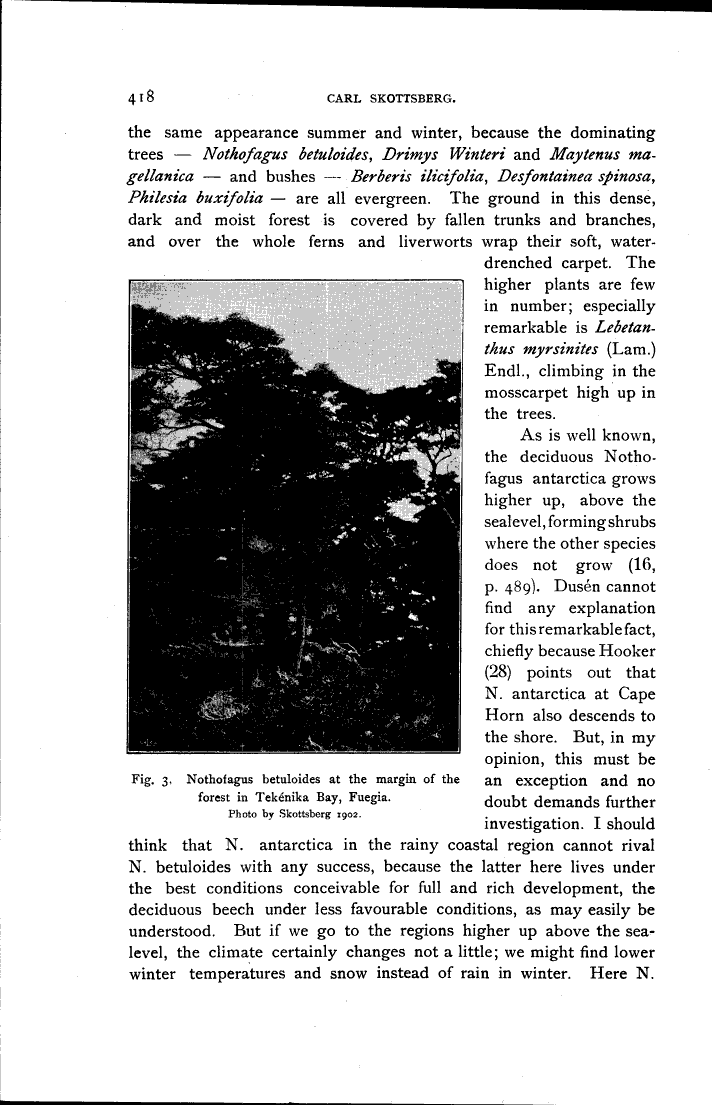
Fig. 3. Nothofagus betuloides at the margin of the
forest in Tekénika Bay, Fuegia.
Photo by Skottsberg 1902.
investigation. I should
think that N. antarctica in the rainy coastal region cannot rival
N. betuloides with any success, because the latter here lives under
the best conditions conceivable for full and rich development, the
deciduous beech under less favourable conditions, as may easily be
understood. But if we go to the regions higher up above the
sea-level, the climate certainly changes not a little; we might find lower
winter temperatures and snow instead of rain in winter. Here N.
<< prev. page << föreg. sida << >> nästa sida >> next page >>

