Full resolution (JPEG) - On this page / på denna sida - The Postal Service
<< prev. page << föreg. sida << >> nästa sida >> next page >>
Below is the raw OCR text
from the above scanned image.
Do you see an error? Proofread the page now!
Här nedan syns maskintolkade texten från faksimilbilden ovan.
Ser du något fel? Korrekturläs sidan nu!
This page has never been proofread. / Denna sida har aldrig korrekturlästs.
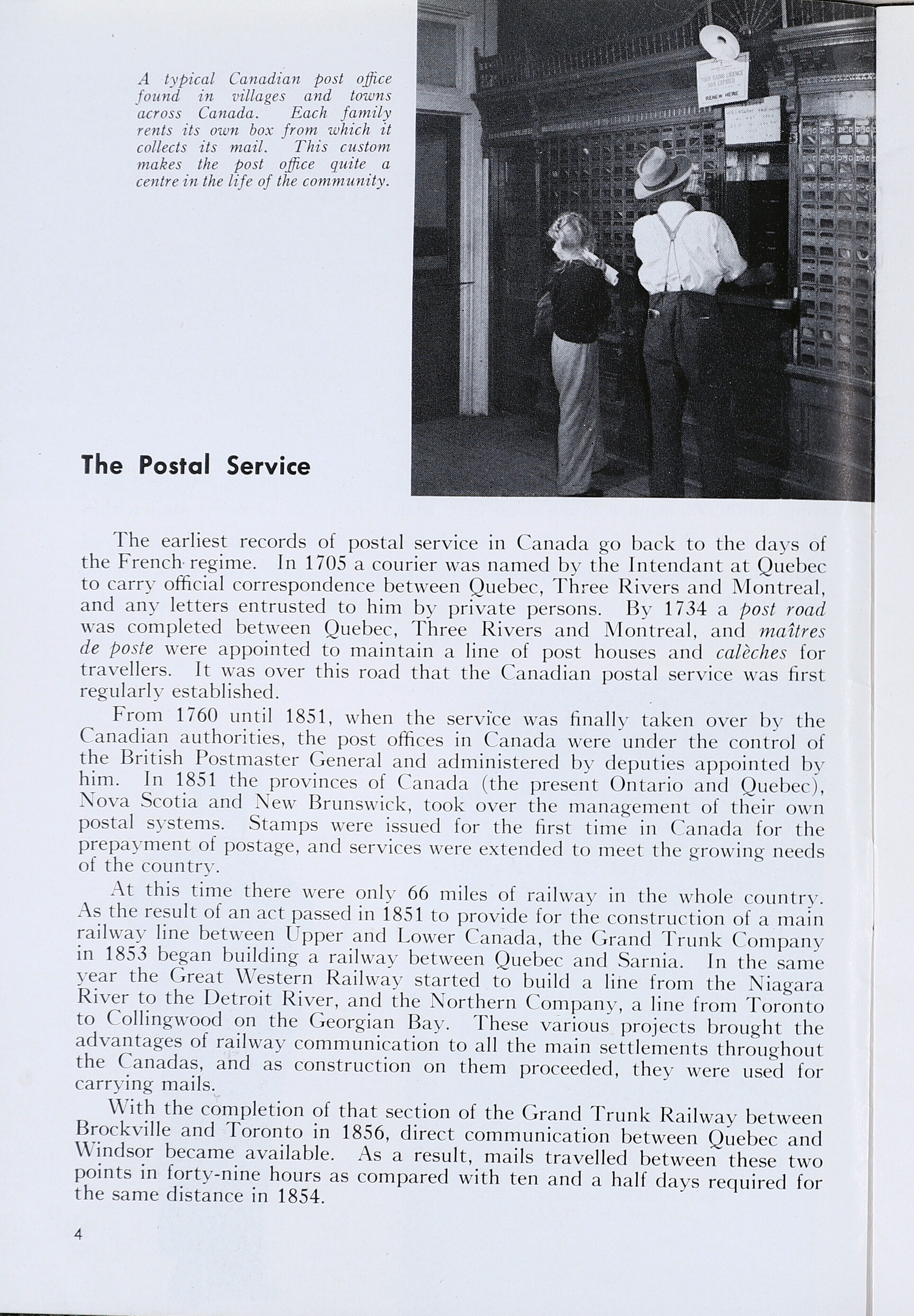
A typical Canadian post office
found in villages and towns
across Canada. Each family
rents its own box from which it
collects its mail. This custom
makes the post office quite a
centre in the life of the community.
The Postal Service
The earliest records of postal service in Canada go back to the days of
the French regime. In 1705 a courier was named by the Intendant at Quebec
to carry official correspondence between Quebec, Three Rivers and Montreal,
and any letters entrusted to him by private persons. By 1734 a post road
was completed between Quebec, Three Rivers and Montreal, and maitres
de poste were appointed to maintain a line of post houses and calèches for
travellers. It was over this road that the Canadian postal service was first
regularly established. |
From 1760 until 1851, when the service was finally taken over by the
Canadian authorities, the post offices in Canada were under the control of
the British Postmaster General and administered by deputies appointed by
him. In 1851 the provinces of Canada (the present Ontario and Quebec),
Nova Scotia and New Brunswick, took over the management of their own
postal systems. Stamps were issued for the first time in Canada for the
prepayment of postage, and services were extended to meet the growing needs
of the country.
At this time there were only 66 miles of railway in the whole country.
As the result of an act passed in 1851 to provide for the construction of a main
railway line between Upper and Lower Canada, the Grand Trunk Company
in 1853 began building a railway between Quebec and Sarnia. In the same
year the Great Western Railway started to build a line from the Niagara
River to the Detroit River, and the Northern Company, a line from Toronto
to Collingwood on the Georgian Bay. These various projects brought the
advantages of railway communication to all the main settlements throughout
the Canadas, and as construction on them proceeded, they were used for
carrying mails.
With the completion of that section of the Grand Trunk Railway between
Brockville and Toronto in 1856, direct communication between Quebec and
Windsor became available. As a result, mails travelled between these two
points in forty-nine hours as compared with ten and a half days required for
the same distance in 1854.
4
<< prev. page << föreg. sida << >> nästa sida >> next page >>