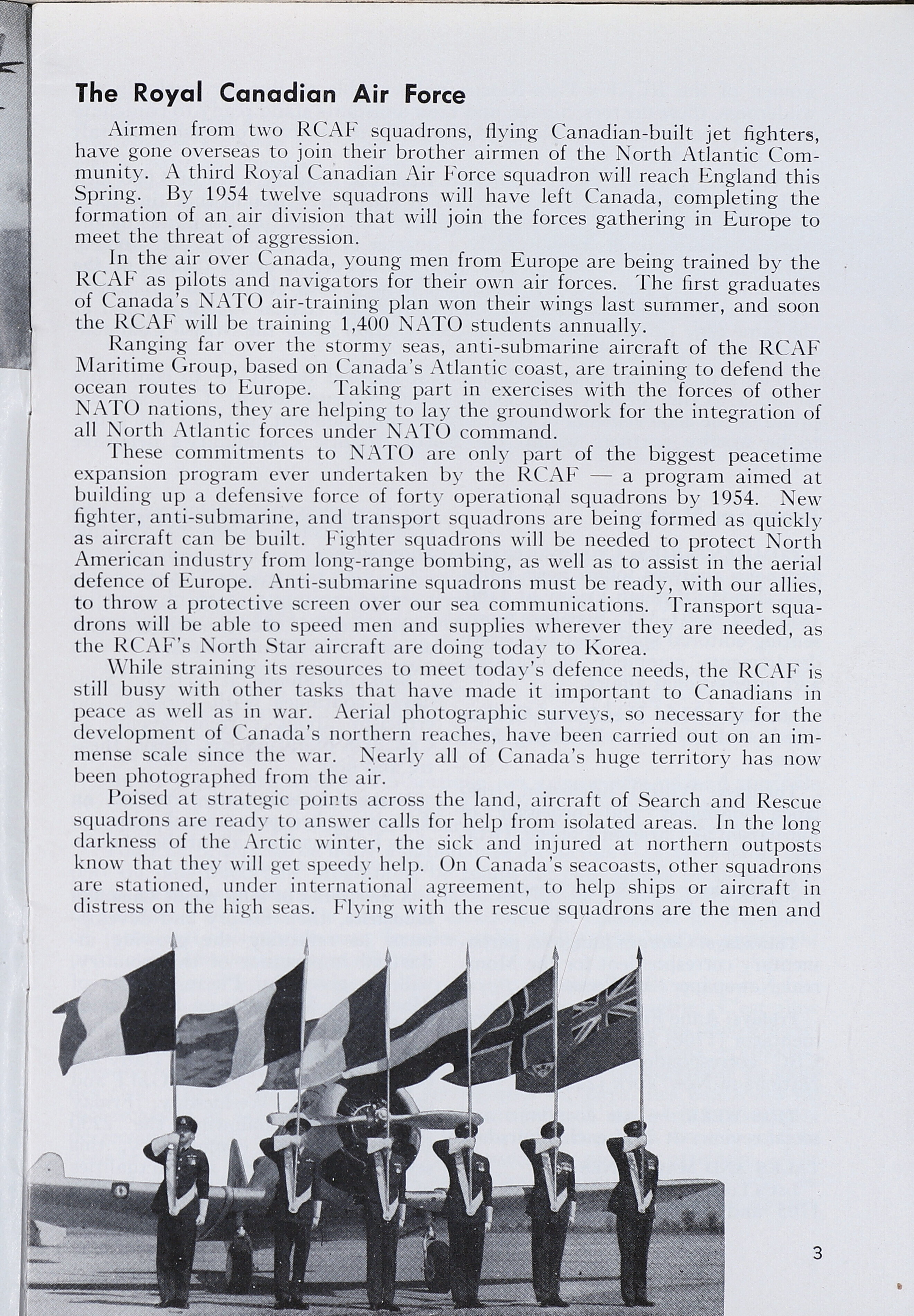
Full resolution (JPEG) - On this page / på denna sida - The Royal Canadian Air Force

<< prev. page << föreg. sida << >> nästa sida >> next page >>
Below is the raw OCR text
from the above scanned image.
Do you see an error? Proofread the page now!
Här nedan syns maskintolkade texten från faksimilbilden ovan.
Ser du något fel? Korrekturläs sidan nu!
This page has never been proofread. / Denna sida har aldrig korrekturlästs.
The Royal Canadian Air Force
Airmen from two RCAF squadrons, flying Canadian-built jet fighters,
have gone overseas to join their brother airmen of the North Atlantic Com-
munity. A third Royal Canadian Air Force squadron will reach England this
Spring. By 1954 twelve squadrons will have left Canada, completing the
formation of an air division that will join the forces gathering in Europe to
meet the threat of aggression.
In the air over Canada, young men from Europe are being trained by the
RCAF as pilots and navigators for their own air forces. The first graduates
of Canada’s NATO air-training plan won their wings last summer, and soon
the RCAF will be training 1,400 NATO students annually.
Ranging far over the stormy seas, anti-submarine aircraft of the RCAF
Maritime Group, based on Canada’s Atlantic coast, are training to defend the
ocean routes to Europe. Taking part in exercises with the forces of other
NATO nations, they are helping to lay the groundwork for the integration of
all North Atlantic forces under NATO command.
These commitments to NATO are only part of the biggest peacetime
expansion program ever undertaken by the RCAF — a program aimed at
building up a defensive force of forty operational squadrons by 1954. New
fighter, anti-submarine, and transport squadrons are being formed as quickly
as aircraft can be built. Fighter squadrons will be needed to protect North
American industry from long-range bombing, as well as to assist in the aerial
defence of Europe. Anti-submarine squadrons must be ready, with our allies,
to throw a protective screen over our sea communications. Transport squa-
drons will be able to speed men and supplies wherever they are needed, as
the RCAF’s North Star aircraft are doing today to Korea.
While straining its resources to meet today’s defence needs, the RCAF is
still busy with other tasks that have made it important to Canadians in
peace as well as in war. Aerial photographic surveys, so necessary for the
development of Canada’s northern reaches, have been carried out on an im-
mense scale since the war. Nearly all of Canada’s huge territory has now
been photographed from the air.
Poised at strategic points across the land, aircraft of Search and Rescue
squadrons are ready to answer calls for help from isolated areas. In the long
darkness of the Arctic winter, the sick and injured at northern outposts
know that they will get speedy help. On Canada’s seacoasts, other squadrons
are stationed, under international agreement, to help ships or aircraft in
distress on the high seas. Flying with the rescue squadrons are the men and
À
I
<< prev. page << föreg. sida << >> nästa sida >> next page >>