
Full resolution (JPEG)
- On this page / på denna sida
- History
<< prev. page << föreg. sida << >> nästa sida >> next page >>
Below is the raw OCR text
from the above scanned image.
Do you see an error? Proofread the page now!
Här nedan syns maskintolkade texten från faksimilbilden ovan.
Ser du något fel? Korrekturläs sidan nu!
This page has never been proofread.
/ Denna sida har aldrig korrekturlästs.
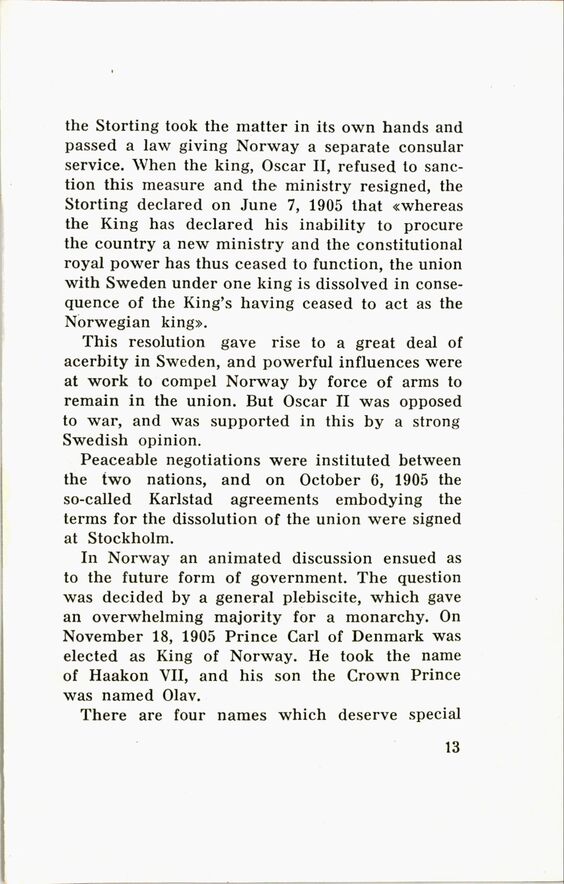
the Storting took the matter in its own hands and
passed a law giving Norway a separate consular
service. When the king, Oscar II, refused to sanc-
tion this measure and the ministry resigned, the
Storting declared on June 7, 1905 that «whereas
the King has declared his inability to procure
the country a new ministry and the constitutional
royal power has thus ceased to function, the union
with Sweden under one king is dissolved in conse-
quence of the King’s having ceased to act as the
Norwegian king».
This resolution gave rise to a great deal of
acerbity in Sweden, and powerful influences were
at work to compel Norway by force of arms to
remain in the union. But Oscar II was opposed
to war, and was supported in this by a strong
Swedish opinion.
Peaceable negotiations were instituted between
the two nations, and on October 6, 1905 the
so-called Karlstad agreements embodying the
terms for the dissolution of the union were signed
at Stockholm.
In Norway an animated discussion ensued as
to the future form of government. The question
was decided by a general plebiscite, which gave
an overwhelming majority for a monarchy. On
November 18, 1905 Prince Carl of Denmark was
elected as King of Norway. He took the name
of Haakon VII, and his son the Crown Prince
was named Olav.
There are four names which deserve special
13
<< prev. page << föreg. sida << >> nästa sida >> next page >>
Project Runeberg, Thu Nov 6 23:31:31 2025
(aronsson)
(download)
<< Previous
Next >>
https://runeberg.org/norway35/0023.html


