Full resolution (JPEG)
- On this page / på denna sida
- Position, Area, and Natural Conditions
<< prev. page << föreg. sida << >> nästa sida >> next page >>
Below is the raw OCR text
from the above scanned image.
Do you see an error? Proofread the page now!
Här nedan syns maskintolkade texten från faksimilbilden ovan.
Ser du något fel? Korrekturläs sidan nu!
This page has never been proofread.
/ Denna sida har aldrig korrekturlästs.
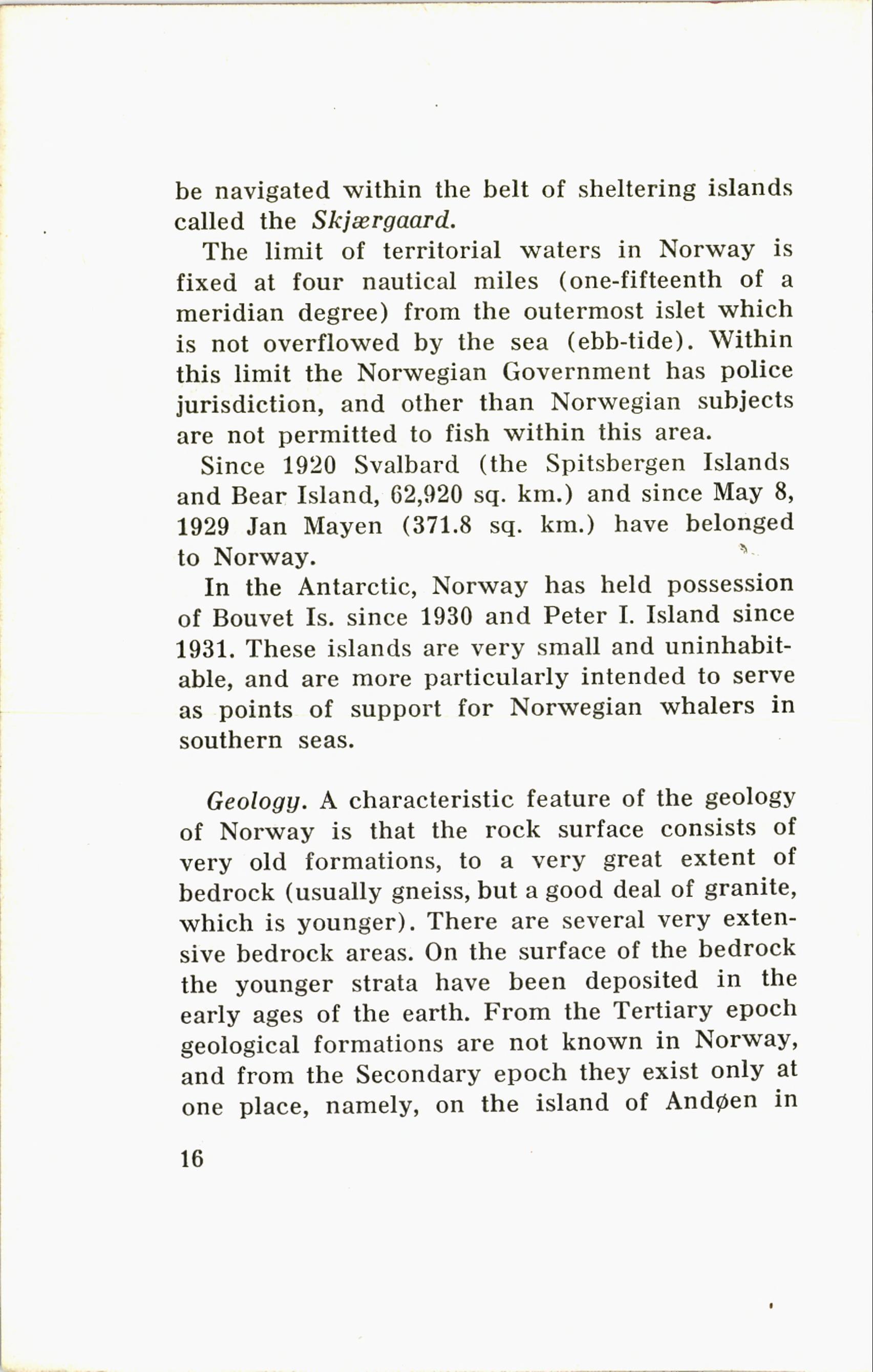
be navigated within the belt of sheltering islands
called the Skjzrgaard.
The limit of territorial waters in Norway is
fixed at four nautical miles (one-fifteenth of a
meridian degree) from the outermost islet which
is not overflowed by the sea (ebb-tide). Within
this limit the Norwegian Government has police
jurisdiction, and other than Norwegian subjects
are not permitted to fish within this area.
Since 1920 Svalbard (the Spitsbergen Islands
and Bear Island, 62,920 sq. km.) and since May 8,
1929 Jan Mayen (371.8 sq. km.) have belonged
to Norway. :
In the Antarctic, Norway has held possession
of Bouvet Is. since 1930 and Peter I. Island since
1931. These islands are very small and uninhabit-
able, and are more particularly intended to serve
as points of support for Norwegian whalers in
southern seas.
Geology. A characteristic feature of the geology
of Norway is that the rock surface consists of
very old formations, to a very great extent of
bedrock (usually gneiss, but a good deal of granite,
which is younger). There are several very exten-
sive bedrock areas. On the surface of the bedrock
the younger strata have been deposited in the
early ages of the earth. From the Tertiary epoch
geological formations are not known in Norway,
and from the Secondary epoch they exist only at
one place, namely, on the island of Andgen in
16
<< prev. page << föreg. sida << >> nästa sida >> next page >>
Project Runeberg, Thu Nov 6 23:31:31 2025
(aronsson)
(download)
<< Previous
Next >>
https://runeberg.org/norway35/0026.html