
Full resolution (JPEG) - On this page / på denna sida - Sidor ...
<< prev. page << föreg. sida << >> nästa sida >> next page >>
Below is the raw OCR text
from the above scanned image.
Do you see an error? Proofread the page now!
Här nedan syns maskintolkade texten från faksimilbilden ovan.
Ser du något fel? Korrekturläs sidan nu!
This page has never been proofread. / Denna sida har aldrig korrekturlästs.
A Survey of the English Conjugation. T
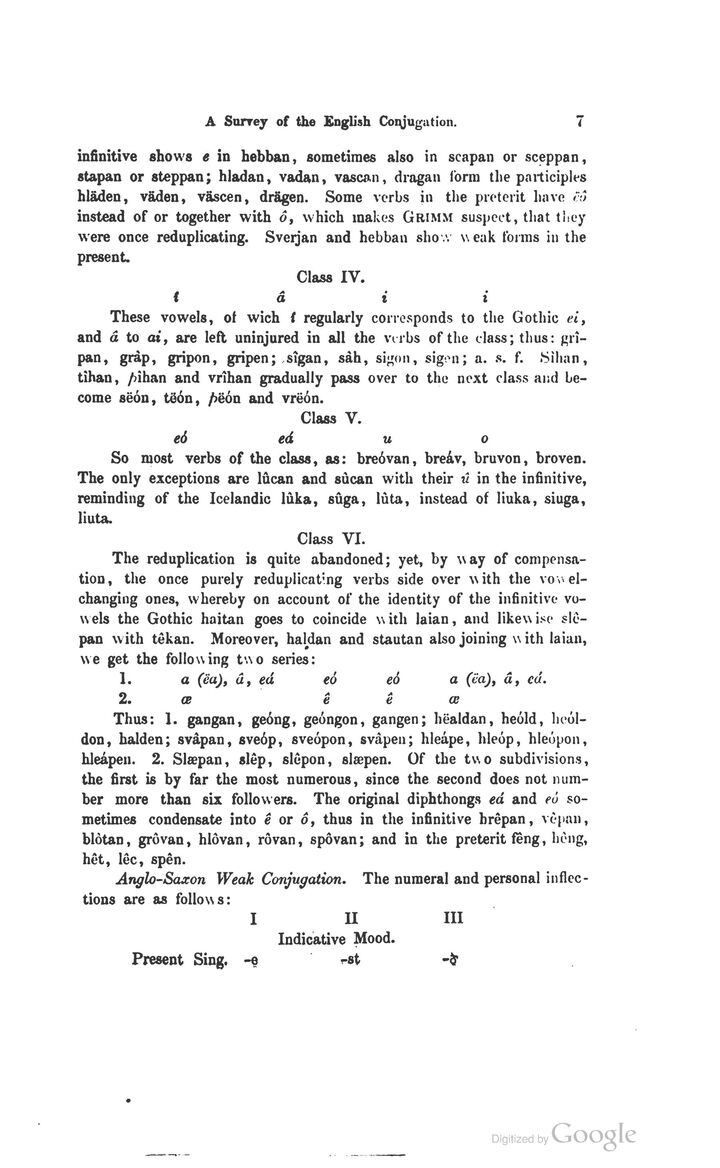
infinitive shows e in hebban, sometimes also in scapan or sceppan,
stapan or steppan; hladan, vadan, vascan, dragan form the participles
hläden, väden, väscen, drägen. Some verbs in the preterit have ös
instead of or together with 6, which makes GRIMM suspect, that tley
were once reduplicating. Sverjan and hebban sho; weak forms in the
present.
Class IV.
t ä t i
These vowels, ot wich £ regularly corresponds to the Gothic ec,
and ä to at, are left uninjured in all the verbs of the class; thus: gri-
pan, gråp, gripon, gripen; .sigan, såh, sigon, sigen; a. s. f. Sihan,
tihan, pihan and vrihan gradually pass over to the next class and be-
come söön, tödn, pödn and vrödn.
Class V.
ed ed u o
So most verbs of the class, as: breévan, breåv, bruvon, broven.
The only exceptions are låcan and såcan with their z in the infinitive,
reminding of the Icelandic låka, såga, låta, instead of liuka, siuga,
liuta.
Class VI.
The reduplication is quite abandoned; yet, by way of compensa-
tion, the once purely reduplicating verbs side over with the von el-
changing ones, whereby on account of the identity of the infinitive vo-
wels the Gothic haitan goes to coincide with laian, and likewise slö-
pan with tékan. Moreover, haldan and stautan also joining with laian,
we get the following two series:
1. a (éa), å, eå ed ed a (éa), ä, ed.
2. e é é &e
Thus: 1. gangan, geöng, geongon, gangen; höaldan, heödld, heol-
don, halden; svåpan, sve6p, sveöpon, svåpen; hleåpe, hleöp, hleöpon,
hleåpen. 2. Slepan, slép, slépon, slepen. Of the two subdivisions,
the first is by far the most numerous, since the second does not num-
ber more than six followers. The original diphthongs ed and es so-
metimes condensate into é or 6, thus in the infinitive hrépan, vepan,
blötan, grövan, hlövan, rövan, spövan; and in the preterit feéng, höng,
hét, léc, spån.
Anglo-Saxon Weak Conjugation. The numeral and personal inflec-
tions are as follows:
I u II
Indicative Mood.
Present Sing, -e rst -&
<< prev. page << föreg. sida << >> nästa sida >> next page >>


