Full resolution (JPEG) - On this page / på denna sida - Sidor ...

<< prev. page << föreg. sida << >> nästa sida >> next page >>
Below is the raw OCR text
from the above scanned image.
Do you see an error? Proofread the page now!
Här nedan syns maskintolkade texten från faksimilbilden ovan.
Ser du något fel? Korrekturläs sidan nu!
This page has never been proofread. / Denna sida har aldrig korrekturlästs.
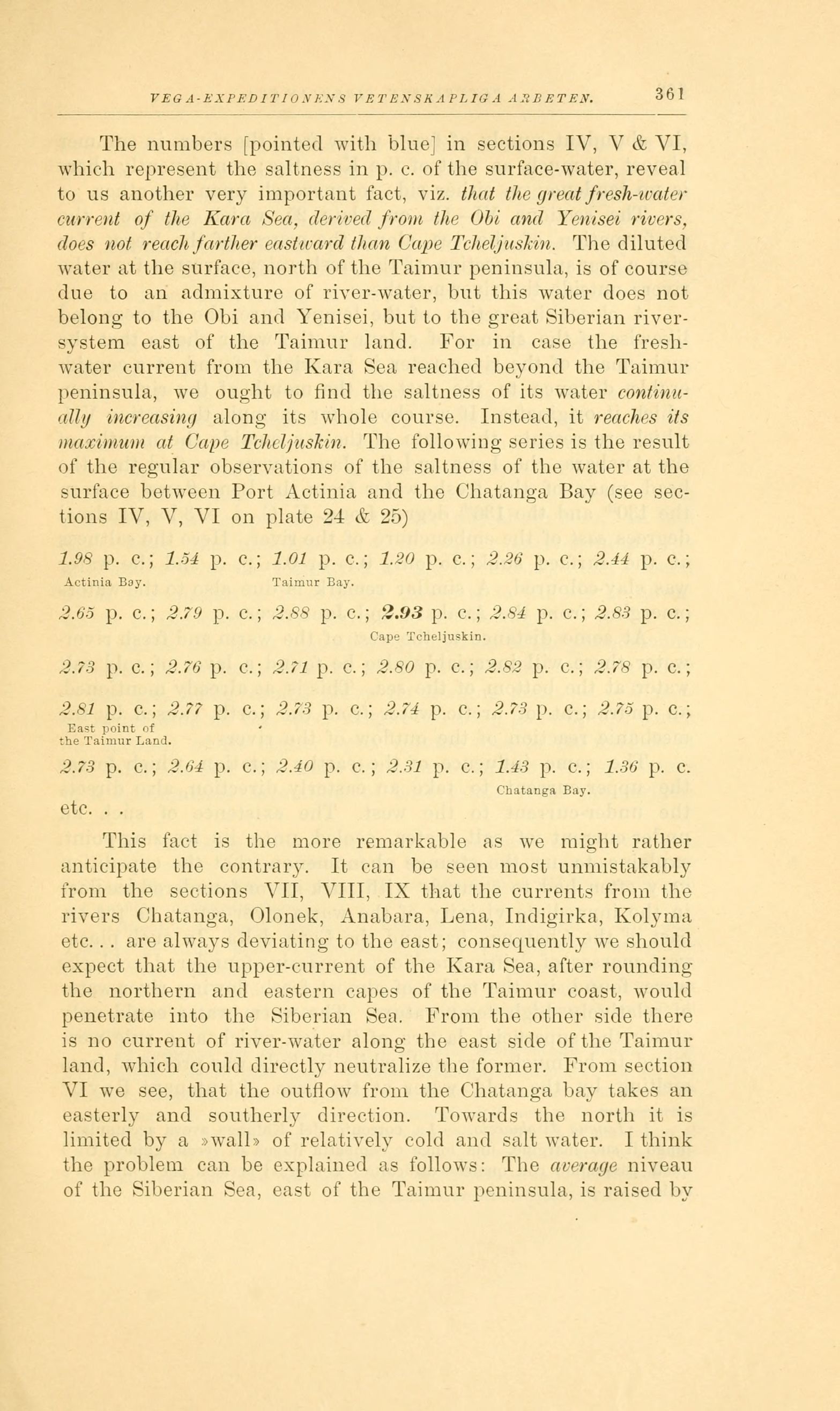
The numbers [pointed with blue] in sections IV, V & VI,
which represent the saltness in p. c. of the surface-water, reveal
to us another very important fact, viz. that the great fresh-water
current of the Kara Sea, derived from the Obi and Yenisei rivers,
does not. reach farther eastward than Cape Tcheljuskin. The diluted
water at the surface, north of the Taimur peninsula, is of course
due to an admixture of river-water, but this water does not
belong to the Obi and Yenisei, but to the great Siberian
river-system east of the Taimur land. For in case the
freshwater current from the Kara Sea reached beyond the Taimur
peninsula, we ought to find the saltness of its water
continually increasing along its whole course. Instead, it reaches its
maximum at Cape Tcheljuskin. The following series is the result
of the regular observations of the saltness of the water at the
surface between Port Actinia and the Chatanga Bay (see
sections IV, V, VI on plate 24 & 25)
1.98 p. c.; 1.54 p. c.; 1.01 p. c,; 1.20 p. c.; 2.26 p. c.; 2.44 p. c.;
Actinia Bay. Taimur Bay.
2.65 p. c.; 2.79 p. c.; 2.S8 p. c.; 2.!f3 p. c.; 2.84 p. c.; 2.83 p. c.;
Cape Tcheljuskin.
2.73 p. c.; 2.76 p. c.; 2.71 p. c.; 2.80 p. c.; 2.82 p. c.; 2.78 p. c.;
2.81 p. c.; 2.77 p. c.; 2.73 p. c.; 2.74 p. c.; 2.73 p. c.; 2.75 p. c.;
East point of
the Taimur Land.
2.73 p. c.; 2.64 p. c.; 2.40 p. c.; 2.31 p. c.; 1.43 p. c,; 1.36 p. c.
Chatanga Bay.
etc. . .
This fact is the more remarkable as we might rather
anticipate the contrary. It can be seen most unmistakably
from the sections VII, VIII, IX that the currents from the
rivers Chatanga, Olonek, Anabara, Lena, Indigirka, Kolyma
etc... are always deviating to the east; consequently we should
expect that the upper-current of the Kara Sea, after rounding
the northern and eastern capes of the Taimur coast, would
penetrate into the Siberian Sea. From the other side there
is no current of river-water along the east side of the Taimur
land, which could directly neutralize the former. From section
VI we see, that the outflow from the Chatanga bay takes an
easterly and southerly direction. Towards the north it is
limited by a »wall» of relatively cold and salt water. I think
the problem can be explained as follows: The average niveau
of the Siberian Sea, east of the Taimur peninsula, is raised by
<< prev. page << föreg. sida << >> nästa sida >> next page >>