
Full resolution (TIFF) - On this page / på denna sida - Introduction
<< prev. page << föreg. sida << >> nästa sida >> next page >>
Below is the raw OCR text
from the above scanned image.
Do you see an error? Proofread the page now!
Här nedan syns maskintolkade texten från faksimilbilden ovan.
Ser du något fel? Korrekturläs sidan nu!
This page has been proofread at least once.
(diff)
(history)
Denna sida har korrekturlästs minst en gång.
(skillnad)
(historik)
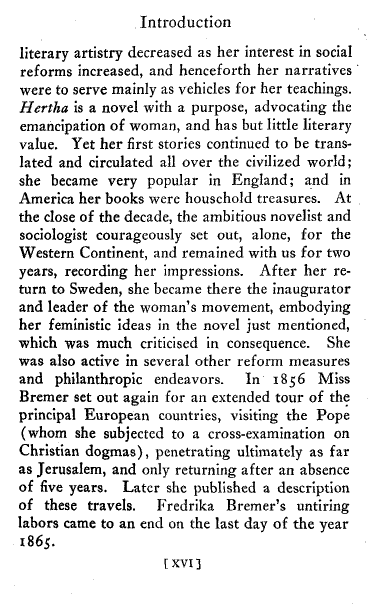
literary artistry decreased as her interest in social
reforms increased, and henceforth her narratives
were to serve mainly as vehicles for her teachings.
Hertha is a novel with a purpose, advocating the
emancipation of woman, and has but little literary
value. Yet her first stories continued to be translated
and circulated all over the civilized world;
she became very popular in England; and in
America her books were household treasures. At
the close of the decade, the ambitious novelist and
sociologist courageously set out, alone, for the
Western Continent, and remained with us for two
years, recording her impressions. After her
return to Sweden, she became there the inaugurator
and leader of the woman’s movement, embodying
her feministic ideas in the novel just mentioned,
which was much criticised in consequence. She
was also active in several other reform measures
and philanthropic endeavors. In 1856 Miss
Bremer set out again for an extended tour of the
principal European countries, visiting the Pope
(whom she subjected to a cross-examination on
Christian dogmas), penetrating ultimately as far
as Jerusalem, and only returning after an absence
of five years. Later she published a description
of these travels. Fredrika Bremer’s untiring
labors came to an end on the last day of the year
1865.
<< prev. page << föreg. sida << >> nästa sida >> next page >>

